Dental Implant Lifespan in Irvine, CA: What Really Lasts
How long do dental implants last in Irvine? We separate the implant post from the crown, debunk the 'forever' myth, and explain what drives real longevity.
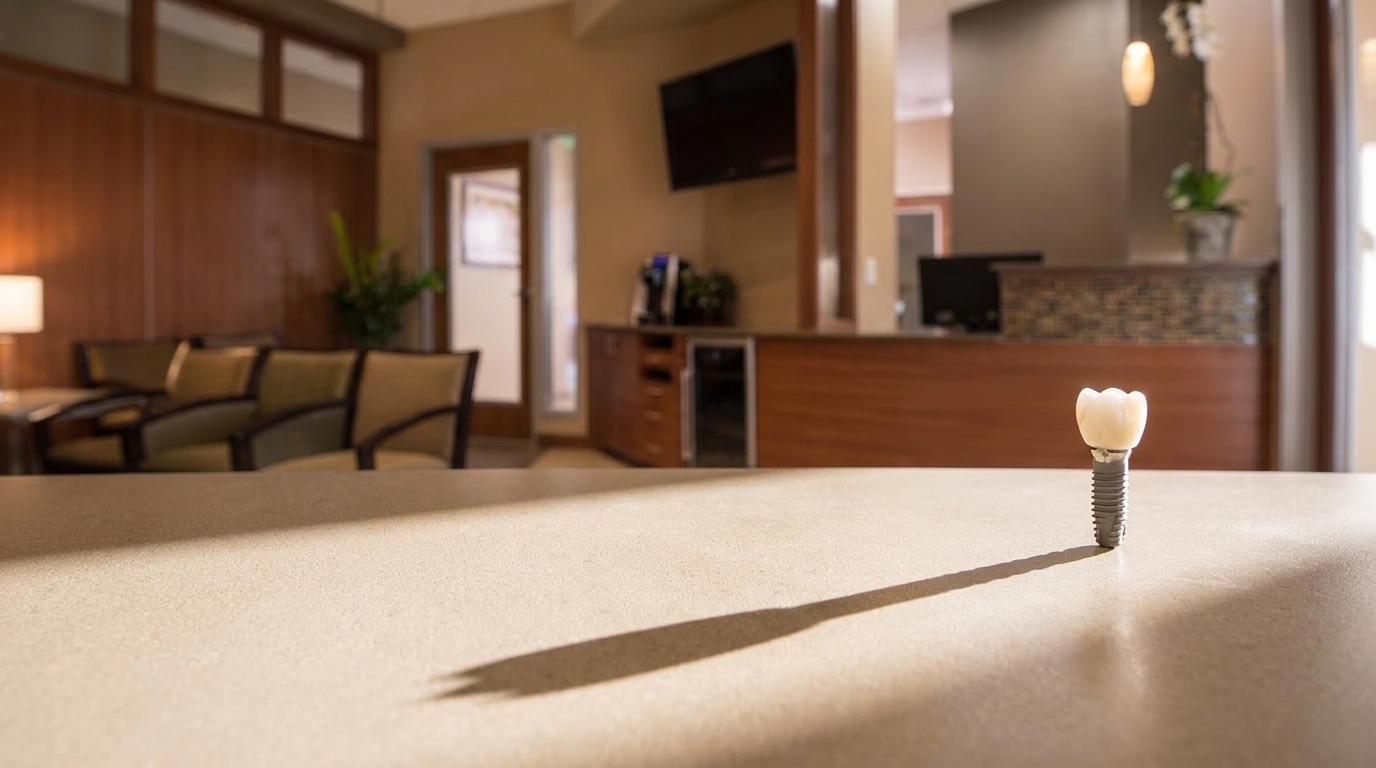
Here's the short answer most Irvine patients don't get up front: a well-placed dental implant post can last a lifetime, but the crown attached to it almost certainly won't. Long-term studies track implant survival at two separate levels — the titanium post anchored in your jaw and the tooth-shaped crown on top — meaning each component carries its own lifespan and its own replacement clock.
That distinction is where the common myth — "implants are permanent, one and done" — falls apart. Below, we unpack what actually determines how long implants last for patients in Irvine, what the research says, and where the real maintenance costs show up over the long term.
Do dental implants really last forever?
No — not in the way most people mean. According to the American Academy of Periodontology, a dental implant can last a lifetime with a proper oral health routine, but "the implant" in that statement refers to the titanium post surgically inserted in the jawbone. The crown, abutment, and surrounding gum and bone tissue each have their own failure risks and timelines that "lifetime" language quietly glosses over.
The implant body is made of titanium and other biocompatible materials and functions as a replacement tooth root. Once osseointegration is complete — a process that can take up to several months as bone grows around the implant — the post becomes a stable foundation. Stable, however, is not the same as maintenance-free. Peri-implant tissues can inflame, crowns can chip, and screws can loosen. The post surviving is the floor of success, not the ceiling.
What's the difference between implant post longevity and crown longevity?
The implant post is the titanium root in your jawbone; the crown is the visible tooth cemented or screwed onto it. Clinical data consistently shows that the vast majority of implant posts remain in place over a decade, while single implant crowns carry a similarly high but distinct survival rate over that same period. The post is engineered to be permanent; the crown is a wearable restoration, closer in lifespan to a natural tooth under heavy chewing load.
That gap matters financially. In California, planning ranges put a single implant with abutment and crown as a significant investment, with the implant post and the porcelain crown each representing separate cost components worth understanding before treatment. If the crown wears out while the post is still solid, you're generally replacing only the restoration — a very different conversation than redoing the surgery. At Rice Dentistry, our reconstructive planning accounts for this split from day one, because treating the post and the crown as one lifespan sets patients up for sticker shock later.
| Component | What it is | Typical 10-year survival | What usually fails |
|---|---|---|---|
| Implant post | Titanium root in jawbone | ~93–96% | Looseness or loss (FDA definition of failure) |
| Abutment | Connector between post and crown | High, but screws can loosen | Screw loosening, wear |
| Crown | Visible porcelain or zirconia tooth | ~95% | Chipping, wear, margin breakdown |
| Peri-implant tissue | Gum and bone around the implant | Varies with hygiene | Peri-implant mucositis, peri-implantitis |
When do dental implants actually need to be replaced?
Implant posts rarely need replacement if osseointegration succeeded and peri-implant tissues stay healthy — the FDA defines implant failure specifically as looseness or loss of the implant. Crowns, by contrast, routinely need repair or replacement over time from normal wear, chipping, or margin breakdown.
The honest timeline for an Irvine patient looks something like this: a successfully integrated implant post may never need to be touched again, while the crown attached to it may be refurbished or replaced once or twice over a lifetime. If a post does fail, it's usually within the first year (early failure, often integration-related) or many years later from peri-implantitis — the inflammatory condition that erodes the bone holding the implant in place.
What actually shortens implant lifespan in Irvine patients?
Four factors drive the majority of premature implant failures: peri-implant disease, smoking, uncontrolled diabetes, and prior periodontal disease. The American Academy of Periodontology lists all four as recognized risk factors for peri-implant disease, and the FDA specifically notes that smoking may affect healing and decrease long-term implant success. None of these are climate or geography issues — they travel with the patient, which is why individual clinical assessment matters far more than where you live.
Peri-implant disease comes in two forms. Peri-implant mucositis is gum inflammation around the soft tissues of the implant with no bone loss — reversible with cleaning and improved home care. Peri-implantitis is the more serious form, involving bone loss, and the AAP notes it usually requires surgical treatment. Catching inflammation at the mucositis stage is the single biggest lever a patient has on long-term implant survival, and it's why professional monitoring on a predictable schedule isn't optional.
How does Irvine's local market affect long-term implant care?
Irvine sits inside the competitive Orange County dental market, where patients routinely compare providers across a wide geographic radius. For implants specifically — a multi-stage treatment involving surgery, several months of osseointegration, restoration, and lifelong follow-up — scheduling continuity matters more than most patients realize. Switching practices mid-treatment, or choosing a provider inconvenient enough that you skip maintenance visits, is a quiet driver of long-term complications.
California's higher cost of living pushes implant pricing at or above national averages, which is reflected in the state planning ranges above. Dental implant systems are regulated as medical devices by the FDA, and California dental practice is additionally regulated by the Dental Board of California — patients can and should verify a clinician's license status and any sedation authorization before beginning treatment. For complex cases, access to a specialist with periodontology training is directly relevant to peri-implant disease management; at Rice Dentistry, Dr. Nicolas Ravon holds dental degrees from Europe and America and a specialist certification in periodontology, which matters specifically because peri-implantitis is the condition most likely to end an implant's life prematurely.
What does professional maintenance actually look like over 20 years?
Long-term implant care is less dramatic than most patients expect — and that's the point. Regular hygiene visits, periodic imaging to monitor bone levels around the implant, and prompt treatment of any peri-implant inflammation are the backbone of the protocol. The FDA notes that the healing phase alone may take several months or longer, during which a temporary abutment is typically in place; the long-term maintenance phase simply never ends.
Rice Dentistry employs advanced 3D surgical design for implant placement, which contributes to precise positioning that supports longevity, and our full mouth reconstruction protocol uses six or more implants per arch rather than the traditional All-on-4 system, with a zirconia and layered porcelain prosthesis on titanium connections — a design choice that reflects how differently a 20-year outcome plays out when load is distributed across more posts. The patients who get the most out of modern implant dentistry treat maintenance as a lifetime commitment, not a post-surgery wrap-up.
“I have complete trust in Rice Dentistry. The entire team makes you feel cared for and valued. The administrative team is always friendly, professional, and a pleasure to work with—they make scheduling and every visit so easy. The doctors and clinical staff are truly exceptional. I had a wisdom tooth removed and some bonding done on a chipped front tooth, and both were done so gently and beautifully. My hygienist keeps my teeth spotless and healthy. This office operates with honesty, integrity, and the highest standards of care. I’m so grateful to have found a dental office I can truly trust.
Frequently asked questions about dental implant lifespan in Irvine
Can a dental implant really last a lifetime?
The implant post can — the American Academy of Periodontology states that with a proper oral health routine, a dental implant can last a lifetime. That refers to the titanium root in the jawbone. The crown attached to it typically has a shorter lifespan and may need repair or replacement, as single-crown survival rates over time are meaningfully lower than those of the implant post itself.
How long do implant crowns last compared to the implant post?
Implant posts show roughly 93–96% survival at 10 years and are engineered to be permanent, while implant crowns show about 95% survival at 10 years and function more like a wearable restoration. Crowns commonly need refurbishment or replacement within 10 to 20 years due to chipping, wear, or margin breakdown, even when the underlying implant post remains perfectly stable.
What is the main cause of dental implant failure?
The FDA defines implant failure as looseness or loss of the implant. The two main causes are failed osseointegration (usually within the first year) and peri-implantitis — an inflammatory condition involving bone loss around the implant that, per the American Academy of Periodontology, usually requires surgical treatment. Risk factors include prior periodontal disease, poor plaque control, smoking, and diabetes.
Does smoking really affect how long my implant lasts?
Yes. The FDA states that smoking may affect the healing process and decrease the long-term success of a dental implant. Smoking is also listed by the American Academy of Periodontology as a specific risk factor for peri-implant disease. Patients who smoke should discuss this openly with their provider during planning, because it meaningfully changes the long-term risk profile.
How much does a single dental implant cost in the Irvine area?
California planning ranges put a single implant with abutment and crown between $3,500 and $7,500. CareCredit cost-study averages for California list the implant post at around $2,730 and a porcelain crown at around $2,331. These figures typically exclude bone grafting, extractions, imaging, sedation, and temporary restorations, so written itemized treatment plans are important for accurate comparison.
Will I need to replace my implant crown eventually?
Most likely, yes — though not the post underneath it. Implant crowns experience the same wear forces as natural teeth and commonly need repair or replacement within 10 to 20 years. Replacing only the crown is a much simpler and less costly procedure than replacing the implant itself.
Planning for the long view
The honest answer to "how long do dental implants last in Irvine?" is that the post is designed to be permanent, the crown is designed to be replaceable, and the tissue around both needs you to show up for maintenance for the rest of your life. Patients who internalize that split tend to be the ones whose implants are still functioning decades later. Readers in Irvine who want this evaluated professionally — including a specialist-led look at peri-implant risk factors — can reach Rice Dentistry at (949) 551-5902 or https://irvinedentalcare.com to arrange an in-person or virtual consultation.