Oral Conscious Sedation in Irvine, CA: Will You Remember?
Will you remember your dental procedure under oral conscious sedation? An Irvine, CA guide to memory, awareness, and what actually happens in the chair.
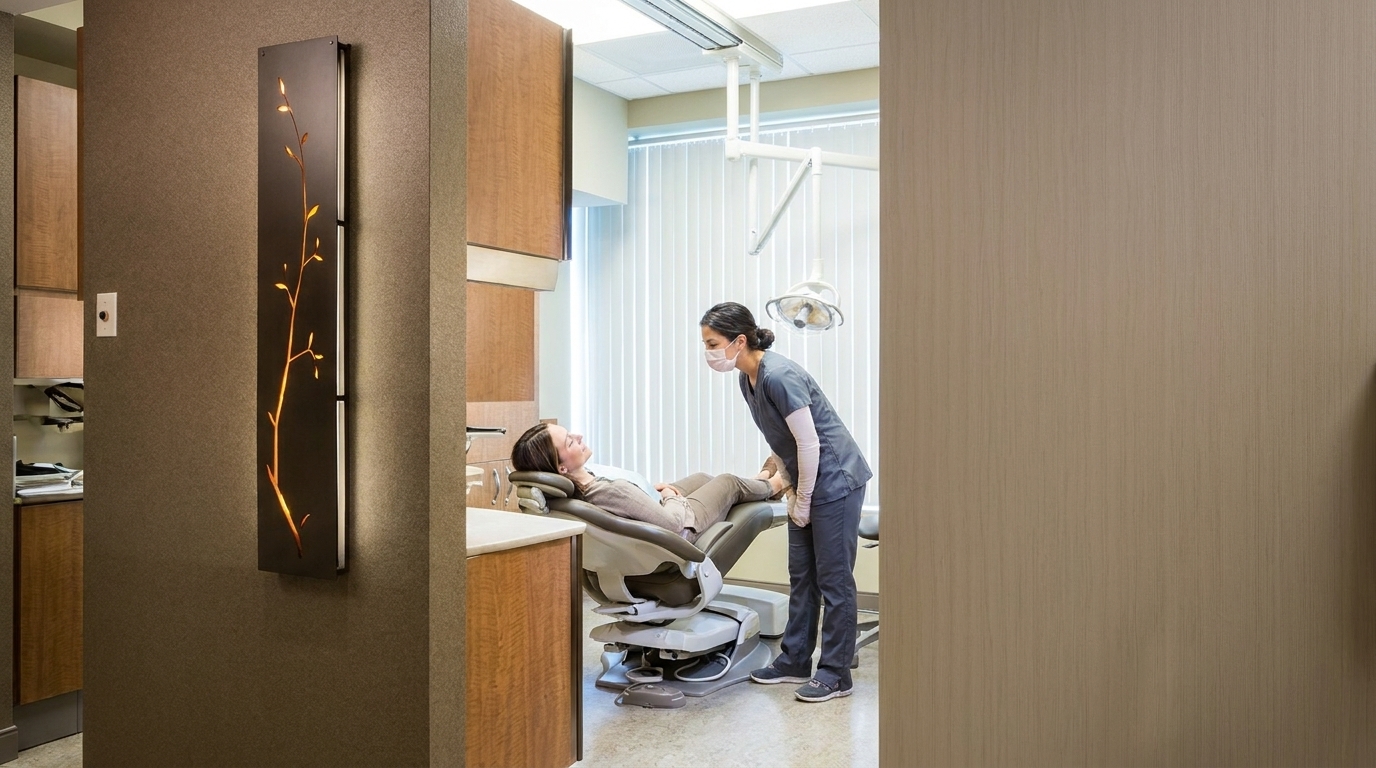
Here is the direct answer: under oral conscious sedation, most patients remember little to nothing of their dental procedure, but you are not fully unconscious — you remain responsive to touch and voice. The blurred or absent memory comes from the medication's amnesic effect, not from being "knocked out." True anesthesia awareness — the fear of "waking up" mid-procedure — is a phenomenon of general anesthesia, not conscious sedation.
That distinction matters, because the most common belief we hear from anxious patients in Irvine is that oral sedation will erase them from the chair entirely, the way general anesthesia does in a hospital. That belief is incomplete. The truth is more interesting, more reassuring, and worth understanding before your appointment.
What does "conscious" actually mean in oral conscious sedation?
Conscious sedation is a drug-induced, minimally depressed state of consciousness in which you can still respond purposefully to verbal instructions or touch, and you maintain your own airway and breathing. You are not unconscious. You are deeply relaxed, detached, and often drowsy — but still, by clinical definition, awake.
The American Dental Association's framework for moderate sedation describes exactly this: a depressed consciousness where the patient still responds to instruction, which is categorically different from general anesthesia, where the patient is fully unconscious. California law reinforces the point, defining adult oral conscious sedation as a minimally depressed level of consciousness produced by oral medication in which the patient maintains the airway independently and responds to stimulation or commands.
So when you ask "will I remember anything?" — the honest answer is that your brain is technically present for the appointment. Whether it files those minutes into long-term memory is a separate question, and that is where the medication's chemistry comes in.
Why don't most patients remember the procedure, then?
Most oral sedation protocols use benzodiazepines, a drug class capable of producing three effects simultaneously: anxiety relief, sedation, and anterograde amnesia — difficulty forming new memories after the medicine takes effect. Your brain stays awake enough to cooperate but loses the ability to record the experience. That is the mechanism behind the common patient report of "I don't remember a thing."
Anterograde amnesia is not a guaranteed outcome for every individual. Response varies by person, by drug, by dose, and by the length and type of procedure. Some patients recall fragments — a voice, a vibration, being helped to stand. Others wake in the car and remember nothing from the moment the medication took hold. Both are normal. Both are consistent with how the drug works.
At Rice Dentistry in Irvine, this is the question we answer most often in pre-sedation consultations, and it is worth separating from the fear underneath it. You are not being erased. You are being shielded from recording a memory you did not want to keep.
Isn't this the same as "waking up" during surgery?
No — and this is the most important myth to dismantle. Anesthesia awareness, the widely discussed phenomenon of regaining consciousness mid-procedure, happens under general anesthesia, not under conscious sedation. The distinction is structural: general anesthesia is the only type of sedation that takes over the body's automatic functions, such as breathing, which is why "awareness" during it is possible in the first place.
According to the Cleveland Clinic, anesthesia awareness under general anesthesia is rare, and patients who experience it may report hearing conversations, feeling in a dreamlike state, waking unable to move, or sensing pressure or, rarely, pain. Some do not remember the event for one or two weeks after surgery, while others experience it immediately but do not report it.
Oral conscious sedation does not produce that scenario, because by clinical definition it never suppresses you to the depth at which "awareness" is a meaningful concept. You are supposed to be responsive. That is the design.
How do the oral sedation and nitrous oxide options compare in Irvine?
Rice Dentistry offers both oral conscious sedation and nitrous oxide, and the two serve different anxiety profiles. The practical differences — onset, memory effect, and recovery — are summarized below.
| Dimension | Oral Conscious Sedation | Nitrous Oxide |
|---|---|---|
| Consciousness level | Minimally depressed; responsive to voice and touch | Light relaxation; fully awake |
| Onset | Oral pill taken before the appointment | Calm, relaxed feeling during inhalation; effects clear relatively quickly |
| Memory of procedure | Often partial or absent (anterograde amnesia from benzodiazepines) | Typically intact |
| Post-visit driving | Not permitted; a companion must drive you | Effects clear relatively quickly after inhalation ends, allowing the patient to drive |
| Monitoring in California | Oxygenation, ventilation, circulation, and consciousness — commonly with continuous pulse oximetry | Standard clinical monitoring |
For patients with severe dental anxiety, oral sedation is usually the better match, precisely because the amnesic effect removes the memory layer that reinforces the fear cycle. For milder nerves or shorter visits, nitrous is often enough.
What should you expect before and after your appointment in Irvine?
Expect to plan the entire day around the appointment, not just the chair time. The medication takes effect well before you sit down and continues to affect judgment, coordination, and memory after you stand up. You will not be permitted to drive. You should arrange a responsible adult to transport you to and from the Laguna Canyon Road office and to stay with you until the drug has cleared.
California dental settings require monitoring of oxygenation, ventilation, circulation, and consciousness during moderate sedation, with continuous pulse oximetry and ventilation monitoring commonly cited. That clinical scaffolding is why oral conscious sedation has the safety profile it does — you are awake, you are breathing on your own, and you are being watched continuously.
Your dentist's specific pre- and post-procedure instructions — about fasting, alcohol, other medications, and the companion requirement — supersede any general guidance, including this article. Follow them exactly.
Who provides oral conscious sedation at Rice Dentistry?
Dr. Scott Rice holds a certification in Oral Sedation Dentistry, along with certifications in Invisalign Orthodontics, Short Term Orthodontics, Laser Dentistry, Advanced Cardiac Life Support, and DSD Digital Smile Design. He has 40 years of experience practicing dentistry. Rice Dentistry offers sedation dentistry options including oral conscious sedation and nitrous oxide, and treatment planning begins with either an in-person or virtual consultation so the sedation approach is tailored to your anxiety level, medical history, and the procedure itself.
For patients in Irvine neighborhoods like Woodbridge, Turtle Rock, Quail Hill, and the Spectrum area, the practical appeal of the Laguna Canyon Road location is proximity — a short drive, a known companion route home, and a schedule that opens Mondays 9:00am–6:00pm and Tuesday through Thursday 7:00am–4:00pm.
Frequently asked questions
Will I be unconscious during oral conscious sedation?
No. Oral conscious sedation produces a minimally depressed level of consciousness in which you maintain your own airway and respond to verbal instruction or touch. You are deeply relaxed, often drowsy, and frequently will not remember the procedure, but you are not unconscious. General anesthesia is the only category that renders a patient fully unconscious.
Can I experience anesthesia awareness under oral sedation in Irvine?
Anesthesia awareness is specific to general anesthesia and does not occur with conscious sedation, because conscious sedation by definition maintains a responsive state. Oral conscious sedation does not create that scenario.
Why do patients say they don't remember anything?
Benzodiazepines, the drug class most commonly used in oral dental sedation, produce anxiety relief, sedation, and anterograde amnesia — difficulty forming new memories after the medicine takes effect. You are conscious enough to respond to instructions during the procedure, but your brain is not reliably recording the experience into long-term memory. That is why most patients describe the appointment as a blur or a blank.
Is oral sedation safe for severe dental anxiety?
For most healthy adults, yes. California requires monitoring of oxygenation, ventilation, circulation, and consciousness during moderate sedation, typically with continuous pulse oximetry. The sedation is specifically designed to keep you breathing on your own and responsive. Your dentist will review your medical history, medications, and anxiety level to confirm that oral conscious sedation is the right fit for you.
How is oral sedation different from nitrous oxide?
Nitrous oxide produces a calm, relaxed feeling during inhalation, and its effects clear relatively quickly afterward, allowing the patient to drive home. Oral sedation involves a pill taken before the appointment, produces deeper relaxation and often memory loss, and does not allow you to drive afterward.
Can I drive myself home after oral conscious sedation?
No. The medication impairs judgment, coordination, and memory well beyond the chair time, and you must arrange a responsible adult to drive you to and from the appointment and remain with you afterward. This is a non-negotiable safety requirement. If you cannot arrange a driver, nitrous oxide may be a better fit for your visit.
The bottom line for anxious patients in Irvine
The honest answer to "will I remember anything?" is: probably not much, and that is by design — not because you were unconscious, but because the medication kept your anxiety-prone brain from filing the appointment into memory. The frightening scenario of "waking up" mid-procedure belongs to general anesthesia, not to the oral sedation used in a dental chair.
Readers in Irvine who want a professional, personalized conversation about oral conscious sedation can reach Rice Dentistry at (949) 551-5902 or https://irvinedentalcare.com to schedule a consultation and build a sedation plan that fits the procedure and the anxiety level you actually have.