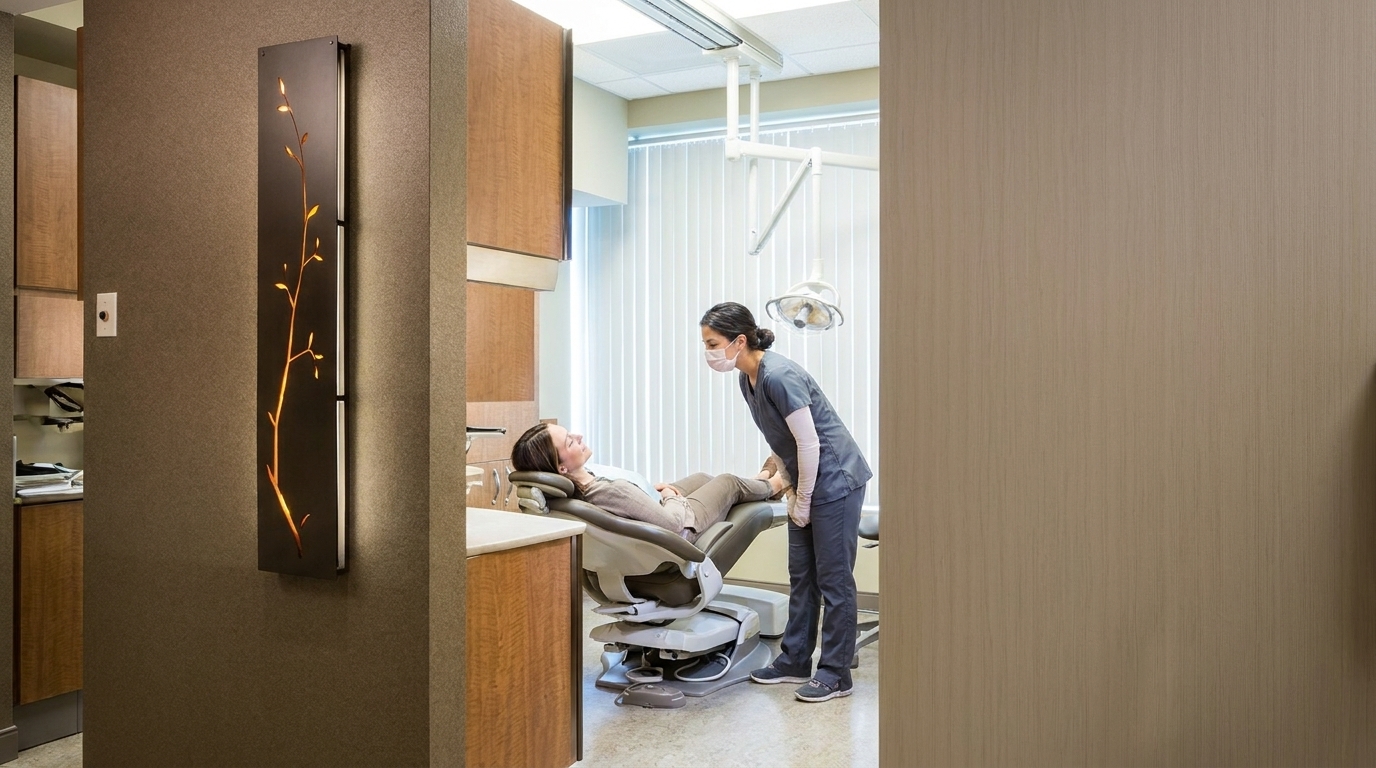
Reconstructive Dentistry in Irvine, CA: What It Is
Learn what reconstructive dentistry covers, when you need it, and how Irvine, CA patients can tell if they're a candidate for treatment in 2026.

Reconstructive dentistry is the branch of dental care focused on repairing or replacing damaged or missing teeth to restore oral health and chewing function. You likely need it if you have cavities, broken or missing teeth, severe tooth wear, or failing older dental work — and when several of those issues occur together, a comprehensive full mouth reconstruction is often the most effective path forward.
For Irvine, CA residents weighing whether this type of care applies to them, the clearest way to self-identify is to match your symptoms to the categories below. Rice Dentistry, located on Laguna Canyon Road near the Irvine Spectrum, evaluates these cases every week, and the framework we use mirrors how most restorative-focused practices approach the decision.
What exactly is reconstructive dentistry?
Reconstructive dentistry — also called restorative dentistry — focuses on repairing or replacing damaged or missing teeth, with the primary goal of improving oral health and chewing function. It differs from cosmetic dentistry, which focuses on the appearance of your smile. The two overlap when a procedure delivers both: a crown, for example, rebuilds a broken tooth while also making the smile look more uniform.
General dentists perform the bulk of restorative work, and the procedure list is familiar: fillings, crowns, bridges, dentures, and dental implants. At Rice Dentistry, the reconstructive services offered include All-on-X, dental implants, full mouth reconstruction, and dental crowns and bridges — the categories that come up most often when a patient has lost structure they can no longer rebuild with a simple filling.
When do you need reconstructive dentistry?
You need reconstructive dentistry when decay, trauma, wear, or tooth loss has outpaced what minor fillings can repair. The clearest triggers are an active cavity, a cracked or broken tooth, a missing tooth, severe enamel wear that has shortened your teeth, or older crowns, bridges, or implants that are failing. Any one of these warrants an evaluation; two or more usually points toward a larger plan.
Cavities and early decay
Early tooth decay often causes no symptoms at all. Later signs include pain, sensitivity to hot or cold, and a visible cavity. Because enamel is the most mineralized tissue in the human body and cannot regenerate once it's lost, a cavity will not heal on its own — it has to be restored. Catching decay at the filling stage keeps you out of crown-and-root-canal territory later.
Broken, cracked, or heavily worn teeth
Teeth break from trauma, from biting hard foods, and — most commonly in adult patients — from years of grinding. Severe tooth wear can cause the vertical dimension of occlusion, the space between the jaws when the teeth meet, to gradually collapse. That collapse shortens the lower facial height and creates a prematurely aged appearance. When multiple teeth are significantly worn, isolated restorations rarely solve the problem; the bite itself needs to be rebuilt to the correct anatomical height and contour.
Missing teeth
A missing tooth is not just a cosmetic issue. Adjacent teeth drift, the opposing tooth over-erupts, and the jawbone beneath the gap begins to resorb. Implants, bridges, and dentures each address this in different ways. Rice Dentistry's full mouth reconstruction protocol uses six or more implants per arch rather than the traditional All-on-4 system, with a Zirconia and layered porcelain prosthesis on titanium connections — a build chosen for long-term structural stability.
TMJ pain and bite instability
TMJ symptoms are often closely linked to occlusal instability, where teeth no longer meet in a balanced and predictable pattern. If jaw soreness, headaches, or clicking accompany your worn or broken teeth, the reconstruction needs to address the bite relationship, not just the individual teeth.
What's the difference between a single restoration and full mouth reconstruction?
A single restoration fixes one tooth; a full mouth reconstruction rebuilds or replaces most or all teeth in the upper and lower jaws as one coordinated plan. Single restorations work when the rest of the mouth is healthy. Full mouth reconstruction becomes the right answer when wear, decay, or tooth loss is widespread enough that treating teeth one at a time would fight itself.
| Situation | Typical approach | Primary goal |
|---|---|---|
| Single cavity, otherwise healthy mouth | Filling, inlay, or onlay | Preserve the tooth |
| One broken or root-canal-treated tooth | Crown | Restore chewing function and strength |
| One missing tooth | Implant or bridge | Replace the tooth, preserve bone and alignment |
| Multiple missing teeth in one arch | All-on-X implant prosthesis | Restore a full arch on implants |
| Widespread wear, decay, or failing work | Full mouth reconstruction | Rebuild bite, function, and structure together |
An inlay fills the area between the cusps of a tooth, while an onlay also covers at least one cusp — useful distinctions when a filling isn't enough but a full crown would remove more structure than necessary.
Who is a candidate for reconstructive dentistry in Irvine, CA in 2026?
You're a candidate if you have one or more of the following: untreated decay, cracked or broken teeth, one or more missing teeth, visibly shortened or flattened teeth from wear, chronic jaw or bite discomfort, or older crowns, bridges, dentures, or implants that are failing. Age is not the gating factor — structural damage is.
Irvine patients tend to come in through two doors. The first is a specific event: a cracked molar, a lost crown, a tooth that finally gave out. The second is accumulation: years of grinding, acidic drinks, or postponed care have reached the point where the mouth as a whole needs attention. Both paths lead to the same evaluation — a thorough exam, imaging, and a staged plan. Rice Dentistry offers both in-person and virtual consultations for this initial assessment, which is useful for patients commuting in from elsewhere in Orange County or scheduling around work near the Spectrum.
How does Rice Dentistry approach reconstructive cases?
Rice Dentistry approaches reconstructive cases by planning the finished bite first, then working backward to the individual restorations. The practice uses advanced 3D surgical design for implant placement, which matters most in full-arch cases where implant angulation drives the fit of the final prosthesis. Sedation options — oral conscious sedation and nitrous oxide — are available for patients who find longer appointments difficult.
I have not been to the dentist in years due to a combination of fear and finances. But my second mom speaks so highly of Doctor Rice and his team, I finally decided to schedule a consultation. I cannot say enough about the care and compassion that Doctor Rice and Wendy showed me. Although I’m not exactly looking forward to having dental work done, I am so excited to see the finished look and to have my healthy teeth back.
Dr. Scott Rice has 40 years of experience practicing dentistry, and Dr. Nicolas Ravon holds dental degrees from Europe and America along with a specialist certification in periodontology — relevant on reconstructive cases where gum and bone health determine whether implants and crowns will last.
Frequently asked questions
Is reconstructive dentistry the same as cosmetic dentistry?
No. Reconstructive dentistry focuses on improving oral health and function, while cosmetic dentistry focuses on improving the appearance of your smile. The two overlap — a crown restores chewing function but can also make a smile look more uniform — but the driver is different. Reconstructive care is prescribed because of structural damage; cosmetic care is elected for appearance.
Can a cavity heal on its own if I brush more carefully?
No. Enamel is the most mineralized tissue in the human body and does not regenerate once it is lost. Improved hygiene can slow or arrest very early demineralization, but a true cavity — a cavitated lesion through the enamel — requires a filling or other restoration. Waiting typically means a larger restoration later, often a crown or root canal.
How do I know if I need full mouth reconstruction instead of individual fixes?
Full mouth reconstruction is appropriate when damage is widespread — multiple missing or broken teeth, severe wear across the arch, collapsed bite height, or failing older restorations throughout the mouth. If treating teeth one at a time would leave an unbalanced bite, a coordinated reconstruction is usually more durable and more predictable than a series of isolated fixes.
What causes severe tooth wear?
The most common causes are nighttime grinding (bruxism), clenching, acidic diet, acid reflux, and age-related wear. Over years, these mechanisms can collapse the vertical dimension of occlusion — the space between the jaws when the teeth meet — shortening the lower facial height and contributing to an aged appearance. Rebuilding the bite restores both function and facial proportions.
Are dental implants always part of reconstructive dentistry?
Not always. Implants are one option among several — bridges, dentures, crowns, and inlays or onlays are also restorative tools. Implants are often preferred for replacing missing teeth because they preserve jawbone and don't rely on adjacent teeth for support, but the right choice depends on how many teeth are missing, bone volume, gum health, and your overall treatment goals.
Where can I get reconstructive dentistry in Irvine, CA?
Reconstructive dentistry is available at general dental practices in Irvine that offer restorative services, including Rice Dentistry at 15785 Laguna Canyon Rd Ste 200. Services typically offered locally include dental implants, All-on-X full-arch restorations, full mouth reconstruction, and dental crowns and bridges. Start with a consultation and imaging so the provider can scope the case accurately.
Next steps for Irvine, CA readers
If any of the signs above describe your mouth — a broken tooth you've been ignoring, visible wear that's shortened your smile, missing teeth you've learned to chew around, or old crowns that feel loose — the useful next step is a proper evaluation, not a guess. Irvine, CA readers who want reconstructive dentistry handled by a practice that plans the full bite rather than one tooth at a time can reach Rice Dentistry at (949) 551-5902 or https://irvinedentalcare.com to schedule a consultation.