Smile Makeover for Stained, Uneven Teeth in Irvine, CA
Veneers can fix stained and uneven teeth in one treatment. Here's how an Irvine smile makeover sequences whitening, bonding, and porcelain for lasting results.
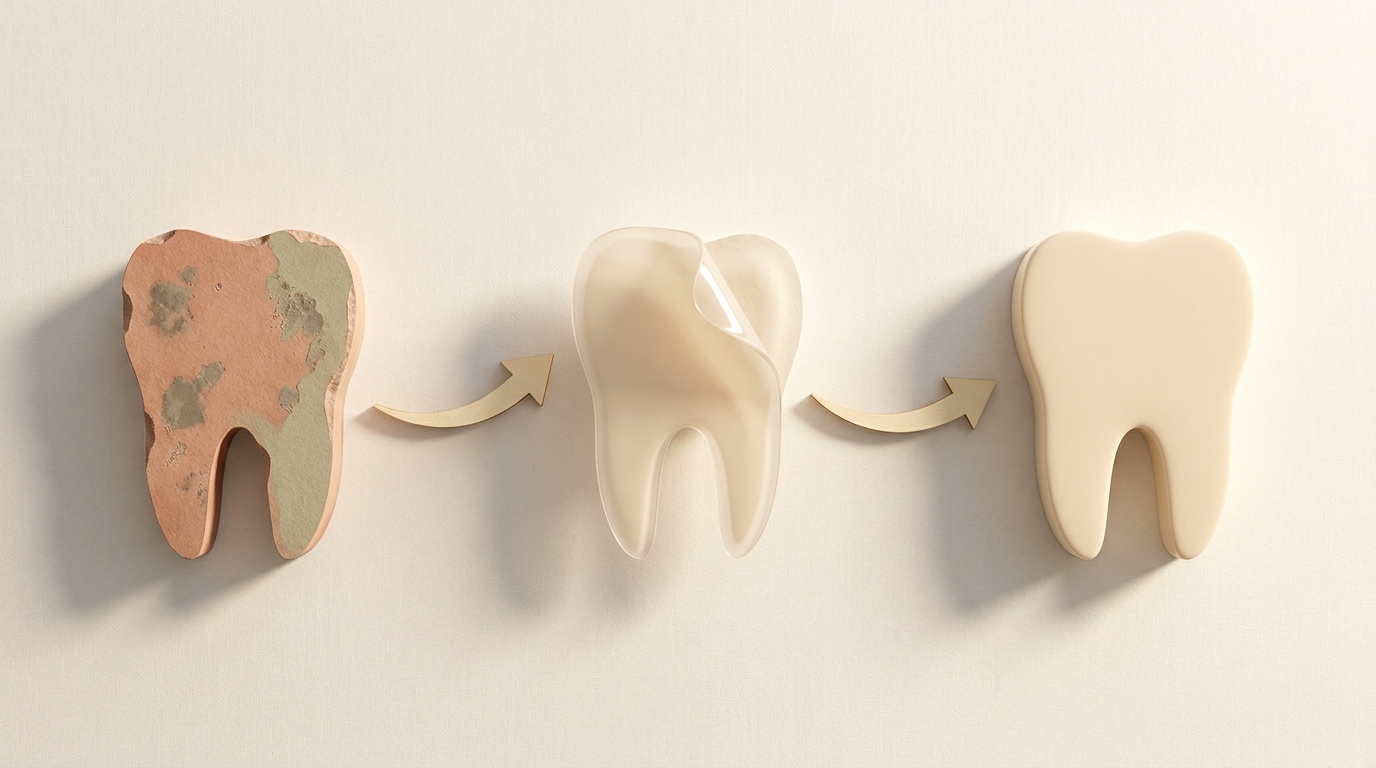
If your teeth are both discolored and slightly uneven, porcelain veneers are the single treatment that addresses both issues at once. Whitening lightens enamel but cannot reshape a tooth, and clear aligners straighten position but cannot change color — veneers are thin custom shells that mask stain and alter visible shape in the same step. For most Irvine patients weighing a smile makeover, veneers are the common denominator, with whitening or short-term alignment sometimes added upstream to reduce how much restorative work is needed.
Why do stained and uneven teeth usually need more than one fix?
Staining and unevenness come from different causes, so they rarely respond to the same tool. Bleaching agents — hydrogen peroxide or carbamide peroxide — break stain molecules into smaller pieces to brighten natural enamel, but they do nothing to tooth shape, edge wear, or spacing. Veneers, by contrast, can correct stained teeth, crooked or misshapen teeth, worn or chipped enamel, and uneven spaces or large gaps between the upper front teeth in a single restorative plan.
That's why a smile makeover is a sequence, not a product. At Rice Dentistry in Irvine, the cosmetic menu — porcelain veneers, hybrid veneers, BioClear, and Invisalign — exists precisely so the plan can be matched to which problem is doing the most visual damage.
Which smile makeover treatment actually fixes both at once?
Porcelain veneers are the only mainstream cosmetic treatment that resolves color and shape simultaneously. Each veneer is a custom shell bonded to the front of a tooth, so the ceramic itself establishes the new color while its contour corrects edge length, minor rotations, and small gaps. Composite resin veneers are the second material option and can do similar work with less enamel removal, though with different wear characteristics.
The practical choice between the two materials comes down to durability versus reversibility and repair:
| Factor | Porcelain (ceramic) veneers | Composite resin veneers |
|---|---|---|
| Enamel removal | Small amount from front and sides of tooth | May require less enamel removal than ceramic |
| Stain and wear resistance | Higher | Generally not as stain- or wear-resistant |
| Repairability | May need re-bonding, repair, or replacement over time | Can be repaired easily and quickly |
| Typical lifespan | Estimated 10–15 years (not a guarantee) | Shorter, with easier touch-ups |
Both options have the same irreversibility caveat: because enamel is removed to seat the veneer, the process cannot be undone. That's not a reason to avoid veneers — it's a reason to plan them carefully with a cosmetic dentist who treatment-plans the full arch, not one tooth at a time.
Where does whitening fit if you're already getting veneers?
Whitening belongs at the front of the sequence, before any ceramic is designed, because whitening only affects natural tooth enamel. Once a veneer is bonded, its color is locked in — so if you plan to brighten the surrounding natural teeth, you do that first, let the shade stabilize, and then match the veneers to the lighter result.
Whitening also sets realistic expectations for stain type. Yellow teeth generally bleach well, but brown teeth may not respond as effectively. Some types of discoloration respond poorly to bleaching, and in those cases veneers become the more predictable fix. Nearly 90% of patients requested tooth whitening in surveys reported by the American Association of Orthodontists, which is why most smile makeovers still start there — but a makeover for stained and uneven teeth almost always moves on to veneers after.
What happens before any cosmetic work begins?
A smile makeover begins with a detailed consultation and any needed foundational work — treating gum disease or cavities — before cosmetic procedures start. That consultation includes an oral health assessment where the dentist examines teeth and gums for decay, cracks, or gum disease and measures the bite to check for clenching or grinding. Active decay or gum inflammation moves to the front of the treatment plan; cosmetic work layered over untreated disease doesn't last.
The bite check matters specifically for veneer candidates. Veneers are not always a good choice for patients who clench or grind their teeth or have a deep overbite, because the thin shells may chip or break. Rice Dentistry handles this foundational phase in-house, with general and preventive services — cleanings, exams, gum disease treatment, and TMJ treatment — on the same roster as the cosmetic menu, so the sequencing stays under one roof. For patients outside the immediate area, Rice Dentistry offers both in-person and virtual consultations to build the initial plan.
What does a stain-and-shape makeover look like step by step in 2026?
A typical sequence for an Irvine patient presenting with both staining and mild unevenness runs in five stages. Each stage has a specific job, and skipping any of them tends to show up later as a result that doesn't hold.
- Consultation and records. Oral exam, bite analysis, photos, and a conversation about the result you're after.
- Foundational care. Any cavities or gum disease are treated first — this is non-negotiable for lasting cosmetic results.
- Alignment or whitening, if indicated. Short-course Invisalign for mild unevenness, or whitening to establish a target shade for the surrounding natural teeth.
- Veneer design and preparation. A small amount of enamel is removed from the front and sides of each prepared tooth so the ceramic sits flush and natural.
- Bonding and bite refinement. Veneers are seated, the bite is adjusted, and a night guard is often recommended if any grinding risk was flagged.
Rice Dentistry has been serving patients in and around Orange County since 1987, and its cosmetic team — including Dr. Scott Rice, who has 40 years of experience practicing dentistry and serves as a Clinical Instructor at the Kois Center — treatment-plans makeovers in this sequence rather than as à la carte services.
What should Irvine patients specifically keep in mind?
Irvine's cosmetic-dentistry market is dense — the Spectrum area and the medical corridor along Laguna Canyon Road sit within close proximity of each other — so the differentiator is rarely access. It's planning depth. A makeover for stained and uneven teeth touches whitening chemistry, periodontal health, bite mechanics, and ceramic design; a practice that offers all of those under one plan avoids the handoffs where results slip.
Any California dentist performing this work must be licensed by the Dental Board of California, and sedation options — Rice Dentistry offers oral conscious sedation and nitrous oxide — require their own permits. If dental anxiety has kept you from pursuing a makeover, confirming those credentials up front is worth doing.
Frequently asked questions
Can whitening alone fix both stained and uneven teeth?
No. Whitening uses hydrogen peroxide or carbamide peroxide to brighten natural enamel, but it does not reshape teeth, close gaps, or correct edge wear. For a patient whose complaint is both color and shape, whitening can be a first step but cannot be the whole makeover — veneers or orthodontics have to address the unevenness.
Are porcelain or composite veneers better for a stain-and-shape makeover?
Porcelain veneers are generally more stain- and wear-resistant and have an estimated 10–15 year lifespan, while composite resin veneers may require less enamel removal and are easier and faster to repair. Porcelain is the typical choice for a full smile makeover; composite is often used when conservation of enamel or quick repairability is the priority.
Is the veneer process reversible if I change my mind later?
No. The veneer placement process cannot be undone because tooth enamel is removed to seat the veneer. That makes the initial design phase the most important part of the plan — you're committing to a restoration pathway, not trialing one, which is why reputable cosmetic practices spend significant time on records and mock-ups before any preparation begins.
Will veneers work if I grind my teeth at night?
Veneers are not always a good choice for patients who clench or grind their teeth or have a deep overbite, because the thin ceramic may chip or break. Grinding doesn't automatically disqualify you — many patients proceed with a protective night guard — but the bite has to be evaluated and addressed before veneers are designed, not after.
How long does a full smile makeover take from start to finish?
Timelines vary by how much foundational work is needed, but most makeovers run several weeks to a few months. Any cavities or gum disease are treated first, then whitening or short-course alignment if indicated, and finally veneer design, preparation, and bonding. Rushing the foundational phase is the single most common reason cosmetic results don't last.
What if my staining comes from medication rather than diet?
Some types of tooth discoloration respond poorly to bleaching. Veneers are usually the more predictable fix in these cases because they mask the existing color rather than trying to lighten it chemically.
Working with Rice Dentistry in Irvine
Readers in Irvine who want a stain-and-shape makeover planned as a single sequence rather than a stack of separate procedures can reach Rice Dentistry at (949) 551-5902 or https://irvinedentalcare.com to schedule a consultation. The practice is located at 15785 Laguna Canyon Rd Ste 200, Irvine, CA 92618, with in-person and virtual consultation options for building the initial treatment plan.