Veneers for Crooked Teeth vs. Braces in Irvine, CA
Can veneers fix crooked teeth in Irvine, CA, or do you really need braces? A clinical candidacy guide to who qualifies, who doesn't, and why.
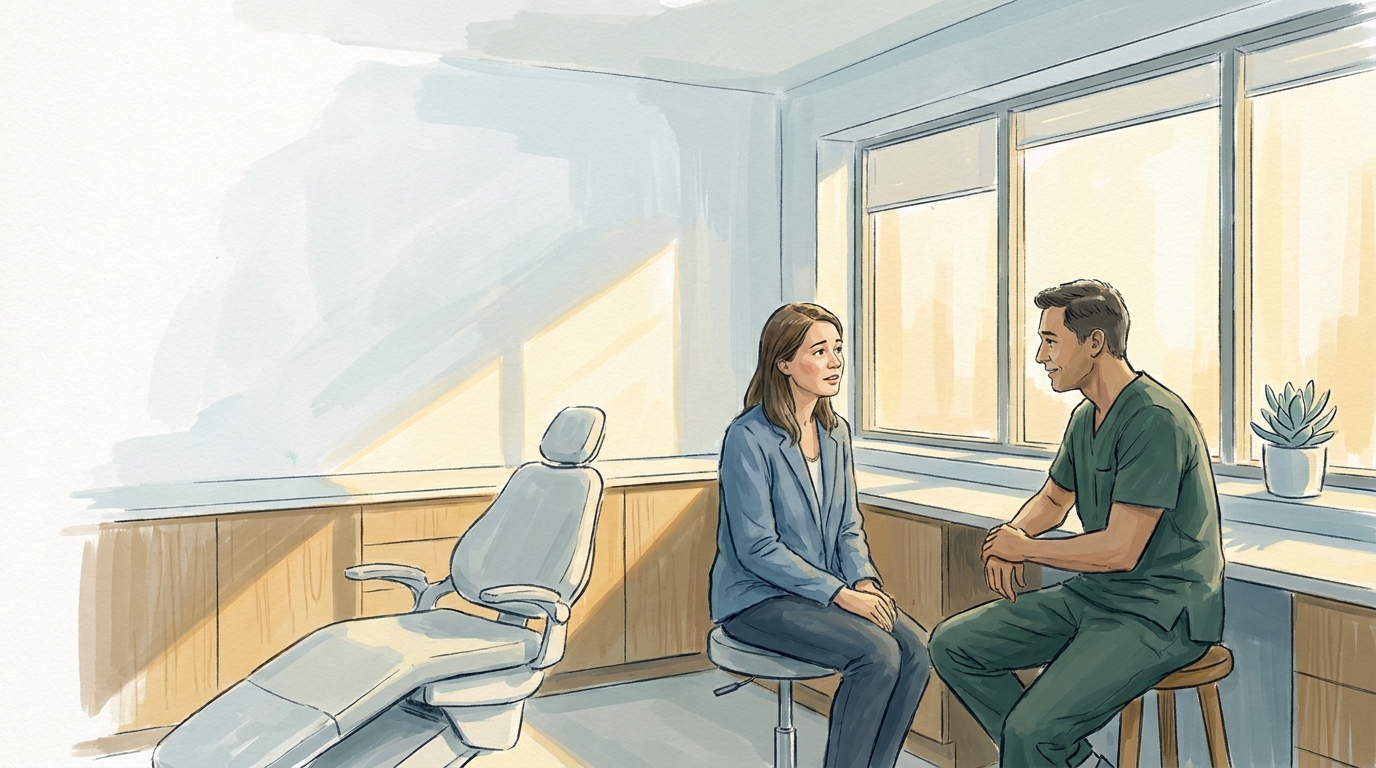
Yes, veneers can make mildly crooked or misshapen teeth look straight by covering the front surface — but they do not actually move teeth or correct a bad bite. For moderate-to-severe misalignment, clenching, grinding, or a deep overbite, veneers are the wrong tool, and orthodontic treatment is the appropriate first step.
That distinction matters because veneer treatment is not reversible — tooth enamel is removed to place a veneer. Choosing the cosmetic shortcut when the clinical answer is orthodontics is a decision you cannot undo. This guide walks through the candidacy criteria an Irvine, CA patient should actually apply before committing.
Can veneers really straighten crooked teeth, or is that a myth?
Veneers do not straighten teeth — they disguise them. Thin porcelain shells are bonded to the front of teeth to change shape, color, symmetry, and size, which can make mildly crooked or misshapen teeth appear aligned. The teeth themselves stay exactly where they were. For true straightening, orthodontics — braces or Invisalign — is what repositions teeth.
The myth that veneers "straighten" teeth comes from before-and-after photos that genuinely do look straighter. What you are seeing is the optical effect of a uniform front surface, not corrected alignment. The underlying bite, the position of the roots, and the way the teeth meet when you chew have not changed. That is why the American Dental Association frames veneers as a cosmetic option for teeth that are chipped, broken, stained, crooked, or misshapen — appearance, not orthodontic correction.
Am I a good candidate for veneers if my teeth are crooked in Irvine, CA?
You are likely a candidate if your crowding or rotation is mild, your bite is healthy, your gums and teeth are free of active disease, and you do not clench or grind. You are likely not a candidate if you have a deep overbite, significant crowding, untreated decay or gum disease, or a bruxism habit — in those cases, veneers may fail prematurely or worsen underlying problems.
Candidacy is a clinical judgment, not a self-assessment. Before placing veneers, a dentist must treat any decay or gum disease, because bonding porcelain over an unhealthy tooth can accelerate the problem underneath. Rice Dentistry, a cosmetic and reconstructive practice in Irvine, CA, evaluates candidacy during a consultation that includes imaging of the teeth and full smile, a discussion of objectives such as closing spaces, whitening, and straightening, and an assessment of gum line aesthetics, symmetry, gum display, and the risk of receding gums.
When are braces or Invisalign the better choice than veneers?
Braces or Invisalign are the better choice whenever the problem is the position of the teeth or the bite, not just the appearance of the front surface. Orthodontic treatment is specifically used to correct malocclusion — crowded or crooked teeth and bad bites. Veneers cannot do this. Choosing veneers to mask a true orthodontic problem leaves the bite uncorrected and the underlying risk in place.
Leaving an abnormal bite uncorrected can lead to tooth decay, gum disease, tooth loss, affected speech and chewing, abnormal wear on enamel, and jaw problems. Most people in orthodontic treatment are in treatment from one to three years, followed by a retainer period. That timeline feels long compared with a few veneer appointments, but it is the only path that actually moves teeth. Rice Dentistry states it is among the top 1% of Invisalign providers in California, which is relevant for Irvine, CA patients who want the straightening done clinically rather than cosmetically masked.
Veneers vs. braces vs. Invisalign for crooked teeth: how do they compare?
The three options solve different problems. The table below summarizes how each one addresses crooked teeth, what it changes, and when it is clinically appropriate.
| Option | What it does | Reversible? | Typical timeline | Best for |
|---|---|---|---|---|
| Porcelain veneers | Covers the front surface of teeth to change shape, color, symmetry, size | No — enamel is removed | A few appointments | Mild cosmetic concerns; healthy bite; no grinding |
| Composite veneers | Same cosmetic goal; less enamel removal, fewer visits, easier to repair but less stain- and wear-resistant | Less invasive but still alters tooth | Often one visit | Budget-sensitive cosmetic cases; interim solutions |
| Braces / Invisalign | Physically repositions teeth and corrects bite | Yes — teeth move back without a retainer | 1–3 years, plus retainer | Moderate-to-severe crowding, rotation, or malocclusion |
Porcelain veneers are strong, long-lasting, and natural-looking, and are typically the more expensive option versus composite. Any veneer may chip, crack, wear down, or loosen over time and require re-bonding, repair, or replacement. Those tradeoffs are acceptable when veneers are the right clinical answer; they become a bad deal when veneers are being used to avoid orthodontics that the patient actually needs.
How many veneers do I need for a smile makeover?
Most smile makeovers involve the teeth visible when you smile — commonly the upper six to ten teeth, sometimes extending to the lower arch for symmetry. The exact number depends on how wide your smile is, how much of each tooth shows, and whether neighboring teeth would look mismatched if left untreated. There is no universal number; the count comes out of the consultation, not a template.
In the Rice Dentistry consultation process, imaging of the full smile and an evaluation of symmetry and gum display drive that decision. A patient with a narrow smile line may need fewer veneers to achieve a cohesive result; a patient with a wide, high-display smile may need more to avoid an obvious transition between veneered and natural teeth. Insurance generally will not help here — veneers are considered cosmetic dentistry and may not be covered unless deemed medically necessary.
Why does this matter specifically for patients in Irvine, CA?
Irvine, CA patients tend to arrive at veneer consultations having already researched Invisalign, in-office whitening, and clear aligner mail-order kits. The Orange County cosmetic dentistry market is competitive and image-conscious, which creates pressure to pick the fastest-looking solution rather than the clinically correct one. The irreversible nature of enamel removal is the reason that pressure should be resisted.
Rice Dentistry is located at 15785 Laguna Canyon Rd Ste 200, Irvine, CA 92618, near the Irvine Spectrum area, and offers both in-person and virtual consultations so patients can get an initial candidacy read before committing to a treatment path. The practice offers cosmetic dentistry including porcelain veneers, hybrid veneers, BioClear, and Invisalign — meaning the recommendation out of a consultation is not biased toward veneers by default; the appropriate tool for the actual diagnosis is on the table.
First time visit (new to the area). Dr Rice and his ENTIRE staff were thorough, professional yet personable and took great time to understand my history and immediate needs.This is an outstanding practice that talks to you, not through you. Well done, Dr Taylor Rice & team.
Frequently asked questions
Can veneers fix an overbite?
No. Veneers cover only the front surface of a tooth and do not change the position of teeth or the way the upper and lower arches meet. If you have a deep overbite, veneers may not be a good choice at all, because the bite forces can damage or dislodge them. An overbite is corrected by orthodontic treatment, not cosmetic dentistry.
Is veneer treatment reversible if I change my mind later?
No. Veneer treatment is not reversible because tooth enamel is permanently removed to place a veneer. Once that enamel is gone, the tooth will always need a veneer, crown, or similar restoration to protect it. That irreversibility is the main reason candidacy evaluation matters so much — the decision cannot be undone later if orthodontics would have been the better path.
Can I get veneers if I grind my teeth at night?
Generally not without addressing the grinding first. If you clench or grind your teeth, veneers may not be a good choice because the repeated forces can chip, crack, or loosen them. A dentist will typically evaluate the grinding habit, discuss a nightguard or other management, and treat any related issues before considering veneers. Skipping that step tends to shorten veneer lifespan significantly.
Does insurance cover veneers in Irvine, CA?
Usually not. Veneers are considered cosmetic dentistry and may not be covered by insurance unless deemed medically necessary — for example, when restoring a tooth after trauma. Most elective smile-makeover cases are paid out of pocket. Patients in Irvine, CA should ask their dentist for a written treatment plan to submit to their carrier for a coverage determination before assuming any portion will be reimbursed.
How long does orthodontic treatment take before I could then consider veneers?
Most people in orthodontic treatment are in treatment from one to three years, followed by a retainer period that holds the teeth in their new positions. Mild crowding or spacing may take 8–12 months, while more complex bite problems may take a couple of years. Some patients choose orthodontics first to correct alignment, then add veneers afterward purely for color and shape refinement.
What happens at a veneer consultation?
At Rice Dentistry, a veneer consultation includes imaging of the teeth and full smile and a discussion of objectives such as closing spaces, whitening, and straightening. The dentist evaluates gum line aesthetics, symmetry, gum display, risks, and the management of possible receding gums. Any decay or gum disease is identified and must be treated before veneers are placed, since bonding over unhealthy teeth can worsen existing problems.
The bottom line for Irvine, CA patients
Veneers are a legitimate cosmetic solution for mildly crooked or misshapen teeth in a healthy mouth with a healthy bite. They are the wrong solution for a true orthodontic problem, a grinding habit, a deep overbite, or untreated gum disease — and because enamel removal is permanent, choosing them for the wrong reason creates a problem that cannot be reversed. The right next step is a candidacy evaluation that honestly considers both veneers and orthodontics.
Readers in Irvine, CA who want a clinical read on which path fits their teeth can reach Rice Dentistry at (949) 551-5902 or https://irvinedentalcare.com to schedule an in-person or virtual consultation.