Dental Implant Consultation in Irvine, CA: What to Expect
Inside an Irvine dental implant consultation: the exam, CBCT imaging, candidacy questions, sequencing, and what the treatment estimate should cover.

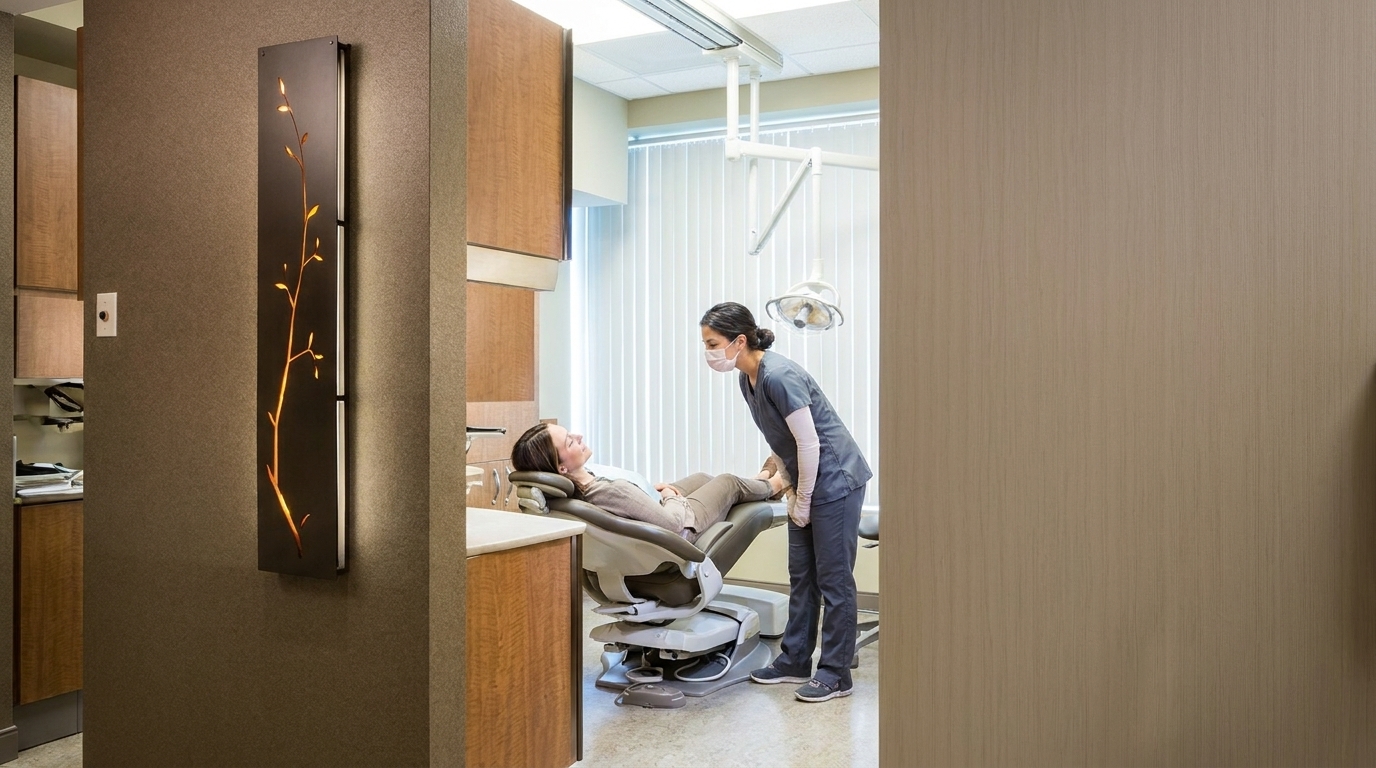
A dental implant consultation in Irvine is a clinical planning visit, not a sales appointment. Expect a conversation about your goals and medical history, a focused oral exam, imaging such as a CBCT scan, and a written treatment plan that outlines sequencing, who performs each phase, and what the estimate covers. Surgery is rarely performed the same day — the findings from the exam and imaging shape the plan first.
What actually happens during a dental implant consultation in Irvine?
A dental implant consultation is a structured diagnostic visit: history intake, extraoral and intraoral exam, digital scans, a CBCT scan to map bone and nerves, and a planning conversation that ends with a proposed sequence and estimate. At Rice Dentistry in Irvine, this workflow is coordinated in one office so planning, surgical placement, and the final restoration stay under one roof.
The visit typically opens with your priorities — are you replacing one tooth, several, or an entire arch? Are you hoping to move away from a removable denture? From there, the clinical team examines your remaining teeth, gums, bite, and the ridges where implants might be placed. Rice Dentistry uses CBCT 3D scanning and digital intraoral technology for comprehensive implant planning, which lets the clinicians measure bone volume and plan implant angulation before anything is committed to.
Am I a candidate for dental implants? How is that decided?
Candidacy for dental implants depends on three things: enough healthy jawbone to anchor the implant, gum tissue free of active infection, and a medical history that supports surgical healing. The consultation answers this by combining the clinical exam with CBCT measurements of bone height, width, and density, then weighing those findings against your health history and medications.
Some patients arrive assuming bone loss disqualifies them and learn that grafting or a staged approach makes implants possible. Others learn that uncontrolled gum disease needs to be treated first. The FDA advises patients considering implants to discuss their health history, bone availability, risks, and ongoing care with their dental professional before proceeding — which is exactly the conversation this appointment is designed to have.
Who performs the surgery, and who makes the final tooth?
Implant care is a two-specialty job: a surgical clinician places the implant in the bone, and a restorative dentist designs and seats the crown, bridge, or full-arch prosthesis on top. At Rice Dentistry, surgical placement is performed by Dr. Nicolas Ravon, an experienced periodontist on the team, while custom crowns, bridges, and full-arch teeth are designed by restorative dentists Dr. Scott Rice and Dr. Taylor Rice.
This matters because many practices send patients between different outside offices for the surgical and restorative phases. Rice Dentistry coordinates every phase in one Irvine office, which reduces handoffs and keeps the surgical plan and the final tooth design aligned from the first appointment.
What imaging and records should I expect at the visit?
Expect digital intraoral scans of your teeth and bite, clinical photographs, periodontal measurements, and a CBCT (cone-beam) scan that shows bone in multiple dimensions. ADA guidance, as summarized in industry literature, holds that imaging should be selected in light of the clinical exam and existing records rather than ordered the same way for every patient — so not every record is captured at every visit.
The CBCT is the record that changes implant planning the most. It reveals sinus position in the upper jaw and the inferior alveolar nerve in the lower jaw — both structures the surgical plan has to respect. Rice Dentistry employs advanced 3D surgical design for implant placement, meaning the implant position is rehearsed digitally before it is placed in bone.
How long does the dental implant process take from start to finish?
From consultation to final tooth, a straightforward single implant typically spans several months because the implant must integrate with bone before a permanent crown is loaded. Cases that require extractions, bone grafting, or sinus work add time; full-arch cases on multiple implants follow a different sequence with provisional teeth in place during healing.
The consultation itself produces the timeline for your case. Below is a general framework for how Irvine patients can expect the phases to stack up — your plan may compress or extend these ranges.
| Phase | What happens | Typical duration |
|---|---|---|
| Consultation & planning | Exam, CBCT, digital scans, written plan | 1 visit |
| Preparatory work (if needed) | Extractions, bone grafting, periodontal therapy | Weeks to months |
| Implant placement | Surgical placement of the implant(s) | 1 visit |
| Osseointegration | Implant fuses with bone before loading | Several months |
| Restorative phase | Final crown, bridge, or full-arch prosthesis designed and seated | Multiple visits |
Single implant, implant bridge, or full-arch — how is that chosen?
The number and position of missing teeth, the condition of neighboring teeth, and the bone available in each site drive the choice. A single implant replaces one tooth without touching its neighbors. An implant-supported bridge uses dental implants anchored in the jawbone to hold several replacement teeth in place without relying on neighboring teeth for support, and healthy neighboring teeth generally do not need preparation solely to anchor the bridge — unlike a traditional bridge where supporting teeth are prepared for crowns.
For patients who are missing or losing an entire arch, Rice Dentistry's Full Mouth Reconstruction uses six or more implants per arch rather than the traditional All-on-4 system, with a Zirconia and layered porcelain prosthesis with titanium connections. An implant-supported bridge is a fixed restoration — the patient does not remove it at home — but it still requires careful cleaning and regular dental examinations. Implants also transfer chewing forces to the surrounding bone, which may help maintain bone in those areas.
What should I bring and ask at the Irvine consultation?
Bring a current medication list, any relevant medical history (especially diabetes, bisphosphonate use, or a history of radiation to the jaw), prior dental records or recent imaging if available, and your dental insurance information. Come with a short written list of priorities and questions so nothing is left for the drive home.
- Am I a candidate, and if not now, what would make me one?
- Which teeth are you proposing to replace, and why that configuration?
- Who performs the surgery and who designs the final tooth?
- What is the full sequence, and how long between phases?
- What does the written estimate include — surgery, abutment, final restoration, imaging, follow-ups?
- What are the risks specific to my case, and what is the plan if an implant does not integrate?
How does the Irvine setting shape the consultation experience?
Irvine patients — whether commuting from the Spectrum area, the Great Park neighborhoods, Woodbridge, Turtle Rock, or nearby Lake Forest and Newport Beach — tend to value appointment access and a plan that fits around work schedules at the business parks along Jamboree and Alton. Rice Dentistry is located at 15785 Laguna Canyon Rd Ste 200, open Mondays 9:00am–6:00pm and Tuesday through Thursday 7:00am–4:00pm, and offers both in-person and virtual consultations to create tailored treatment plans.
California also licenses dental specialties through the Dental Board of California, which matters when you're verifying who is performing surgical phases of implant care versus restorative phases. A consultation that clearly identifies the surgeon and the restorative dentist by name is the baseline you should expect from any Irvine practice.
Frequently asked questions
Will I get my implant placed the same day as the consultation?
Usually no. The consultation is a diagnostic and planning visit — exam, imaging, and a written plan. Immediate placement at the time of an extraction is possible in selected cases, but it is decided after the CBCT and clinical exam, not before. Expect to leave the consultation with a sequenced plan and a separate surgical appointment on the calendar.
Does a dental implant consultation hurt?
No. The consultation involves a visual exam, periodontal measurements with a small probe, digital scans, and a CBCT scan — all non-surgical. If a limited numbing is needed to examine a painful area, it is discussed first. Any discomfort management for the surgical phase, including sedation options, is planned separately once the treatment plan is agreed.
What if I don't have enough bone for an implant?
Insufficient bone is common and usually solvable. Depending on the site, options include ridge preservation at the time of extraction, bone grafting, or a sinus lift in the upper back jaw. The CBCT taken at your consultation is what determines which, if any, of these steps is needed before an implant can be placed predictably.
Will my dental insurance cover the consultation or the implant?
Coverage varies significantly by plan. Many dental plans cover part of the diagnostic exam and imaging and apply limited benefits toward the restorative crown; coverage for the surgical implant itself is less consistent. Bring your insurance information to the consultation so the treatment coordinator can produce an estimate that reflects your specific plan.
How long is the actual consultation appointment?
Plan on roughly an hour. That typically covers intake, the clinical exam, digital scans, a CBCT, a planning discussion with the dentist, and time with a treatment coordinator to review sequencing and the written estimate. More complex cases — full-arch planning, for example — may require a longer visit or a second planning appointment.
Can I have the consultation virtually first?
A virtual consultation is a useful first step for reviewing goals, photos, and history before committing to an in-office visit, and Rice Dentistry offers both in-person and virtual consultations to create tailored treatment plans. A CBCT scan and hands-on exam are still required in person before a surgical plan can be finalized, because bone and tissue measurements cannot be captured remotely.
The bottom line
A thorough implant consultation should leave you with three things: a clear answer on candidacy, a written sequence with timelines, and a named surgeon and restorative dentist for each phase. Readers in Irvine who want implant planning handled in one coordinated office can reach Rice Dentistry at (949) 551-5902 or https://irvinedentalcare.com to schedule an in-person or virtual consultation.