Dental Implants After Extraction Timing in Irvine, CA
How soon can you place a dental implant after tooth extraction in Irvine? Inside the clinical timing decision, healing stages, and what drives the schedule.
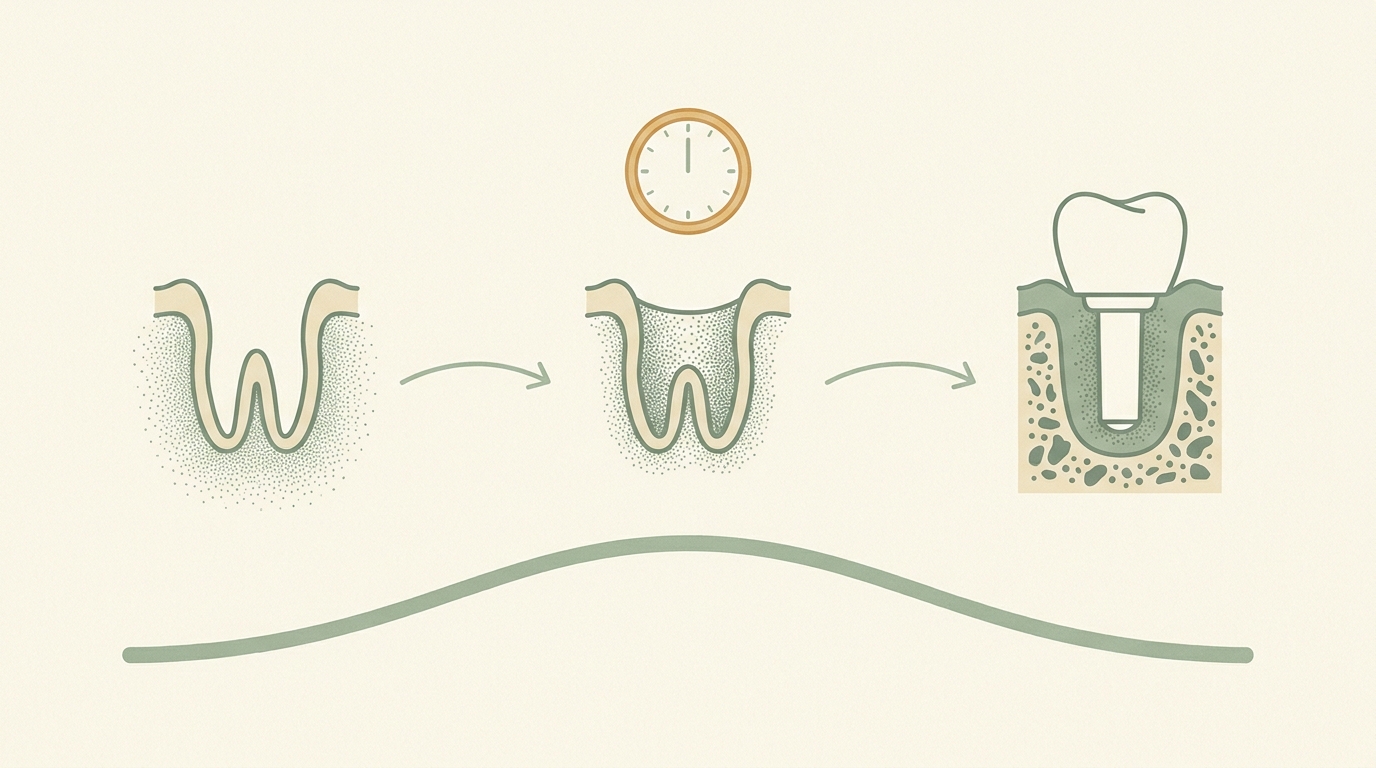
In Irvine, a dental implant can be placed immediately at the extraction visit, after a few weeks of soft-tissue healing, or after several months of delayed healing — the window is chosen by your clinician based on infection status, bone volume, and whether grafting is required. There is no universal rule. The right timing is the one that gives the titanium implant the best chance to fuse with your jawbone over the months of osseointegration that follow.
That single decision — when to place — shapes everything else: the number of visits, whether you need a bone graft, how long you wear a temporary, and when your final crown goes in. This guide takes you under the hood of that decision so you can read your own treatment plan with clearer eyes.
What does "timing" actually mean after a tooth extraction?
Timing refers to when the implant body is placed relative to the extraction: immediate (same visit), early (weeks later, after soft tissue closes), or delayed (several months later, after bone fills the socket). Each pathway ends in the same place — an osseointegrated implant supporting a crown — but the road, the risks, and the number of appointments differ.
The decision is clinical and patient-specific. In Irvine, where dental practice is regulated by the Dental Board of California, no municipal rule dictates the window; your provider's exam and 3D imaging do. At Rice Dentistry, located on Laguna Canyon Road in Irvine and serving patients across Orange County, advanced 3D surgical design is used to map the socket, bone, and adjacent anatomy before a timing recommendation is made.
When is an immediate implant after extraction appropriate?
Immediate placement is appropriate when the socket is free of active infection, enough bone surrounds the site to stabilize the implant, and the surrounding soft tissue is healthy. When those conditions are met, the extraction and the implant body happen in the same visit, which can reduce total treatment stages and preserve socket architecture.
Research supports this pathway in selected cases. Research supports this pathway in selected cases, with clinical studies finding no meaningful difference between immediate and delayed implants in clinical success when appropriate candidates are chosen. Immediate placement, however, does not mean a same-day final crown — the healing phase still requires months before the implant is loaded with its permanent restoration.
When is delayed placement the smarter path?
Delayed placement — waiting weeks to months after extraction — is the smarter path when infection is present, when the bony walls of the socket are compromised, or when a bone graft is needed to rebuild volume before an implant can be anchored. Forcing an immediate implant into a deficient site trades a shorter calendar for a weaker foundation.
According to the U.S. FDA, the healing process for the implant body may take several months or longer, during which the patient typically wears a temporary abutment. According to the U.S. FDA, the healing process for the implant body may take several months or longer, during which the patient typically wears a temporary abutment. If a graft is layered into the timeline, add healing time for that too; adequate peri-implant soft tissue height has been shown to help maintain stable crestal bone levels over the long term, which is why thin tissue may be augmented before or during placement.
What are the stages from extraction to final crown?
A dental implant typically requires multiple stages over several months, including healing time. The exact sequence depends on the timing pathway your clinician recommends, but every pathway passes through extraction, placement, osseointegration, and restoration.
| Stage | What happens | Typical duration |
|---|---|---|
| Extraction & site assessment | Tooth removed; socket evaluated with 3D imaging for bone volume and infection. | Single visit |
| Bone graft (if indicated) | Graft material placed to rebuild ridge; separate healing period before implant. | Several months |
| Implant body placement | Titanium post seated into the jawbone; temporary abutment placed during healing. | Single visit |
| Osseointegration | Implant fuses with bone; usually takes several months. | Several months |
| Abutment & final crown | Permanent abutment attached; custom crown cemented or screw-retained. | 1–2 visits |
A dental implant system consists of a dental implant body and dental implant abutment and may also include an abutment fixation screw — the FDA advises patients to ask their provider for the brand and model of the implant system being used.
What factors push your personal timeline earlier or later?
Six factors do most of the work in moving your timeline: infection in the socket, bone density and volume, soft-tissue thickness, need for grafting, systemic health, and smoking. Each one either shortens the window to placement (healthy, intact socket) or lengthens it (compromised anatomy, biological risk).
Smoking is worth calling out on its own. The FDA notes that smoking may affect the healing process and decrease the long-term success of a dental implant — which can push a borderline case from "immediate" to "delayed" and from "no graft" to "graft required." Soft-tissue height matters too: research has shown that adequate peri-implant soft tissue height helps maintain stable crestal bone levels over the long term, underscoring why tissue quality shapes both timing and long-term outcome.
What does implant treatment typically cost in the Irvine area?
A completed single implant in California is modeled at roughly $4,780 to $7,290 based on editorial estimates for 2026, above the broader U.S. planning range of $3,000 to $6,500 per tooth. California implant costs tend to run above the national reference, reflecting the state's higher cost-of-living and dental-market pricing. These are planning ranges, not quotes.
What's included drives the final number. Extraction, bone graft if needed, imaging, temporary restoration, sedation, laboratory fees, and follow-up may each be billed separately. Medi-Cal does not cover dental implants in California, so virtually all implant costs are out-of-pocket or handled through private insurance. For a case-specific figure, you'll need a written treatment plan from a licensed provider.
How does Rice Dentistry approach the timing decision?
Rice Dentistry approaches extraction-to-implant timing as a clinical read, not a default protocol. The practice employs advanced 3D surgical design for implant placement, which lets the team evaluate bone volume, socket integrity, and adjacent anatomy before committing to immediate, early, or delayed placement. In-person and virtual consultations are both offered to build the initial plan.
The practice has been serving patients in and around Orange County since 1987, and Dr. Scott Rice has 40 years of experience practicing dentistry. For more complex rehabilitations, Rice Dentistry's Full Mouth Reconstruction uses six or more implants per arch rather than the traditional All-on-4 system, with a Zirconia and layered porcelain prosthesis with titanium connections. Sedation options including oral conscious sedation and nitrous oxide are available for patients who need them during surgical visits.
Frequently asked questions
Can I get a dental implant the same day as my tooth extraction in Irvine?
Yes, in selected cases. Immediate implant placement at the extraction visit is appropriate when the socket is free of active infection, the surrounding bone is intact, and soft tissue is healthy. Your provider will use clinical exam and 3D imaging to confirm you are a candidate. Same-day placement does not mean a same-day final crown — osseointegration still takes several months.
How long does osseointegration take after an implant is placed?
Osseointegration — the biological fusion of the titanium implant with your jawbone — usually takes several months regardless of whether placement was immediate or delayed. During this window, patients typically wear a temporary abutment while healing progresses.
What happens if I wait too long between extraction and implant?
Waiting too long can lead to bone resorption in the empty socket, which may require a bone graft before an implant can be placed. Grafting adds a separate healing period of several months to your timeline and additional cost. Your provider can evaluate ridge volume with 3D imaging and tell you whether grafting will be needed.
Do dental implants really work? What is the success rate?
Dental implants have a well-documented track record of clinical success, and the American Association of Oral and Maxillofacial Surgeons recognizes them as a reliable tooth-replacement option. Success depends on adequate bone, healthy soft tissue, good oral hygiene, and systemic factors such as smoking, which the FDA notes can decrease long-term success. Proper timing of placement after extraction is one of several factors clinicians manage to protect that outcome.
Does insurance or Medi-Cal cover dental implants in California?
Medi-Cal does not cover dental implants in California — the standard implant procedure codes carry no allowance in the state fee schedule, meaning implant costs are generally out-of-pocket or handled through private insurance. Coverage from private dental plans varies widely by policy. Patients should request a written treatment plan and verify benefits with their insurer before starting treatment.
Is a dental implant always better than a root canal after a damaged tooth?
Not always. A root canal is often completed in one to two visits followed by final restoration, while a dental implant typically requires multiple stages over several months including healing time. When a natural tooth can be predictably saved with endodontic treatment, that is often the faster and more conservative path. When the tooth cannot be saved, implants become the restorative option.
The bottom line on timing
The right extraction-to-implant window is the one your anatomy and biology support, not the fastest one on the calendar. Immediate placement rewards clean, intact sites; delayed placement protects compromised ones; and a well-executed delayed plan can match the long-term outcome of an immediate one. Ask your provider which pathway your imaging supports and why.
Readers in Irvine who want this evaluated professionally can reach Rice Dentistry at (949) 551-5902 or https://irvinedentalcare.com to schedule an in-person or virtual consultation and get a treatment plan built around their specific case.