Dental Implants vs Bridge: Which Is Better in Irvine, CA
Comparing dental implants and bridges in Irvine? See how cost, longevity, and tooth preservation stack up — and which option fits which patient.
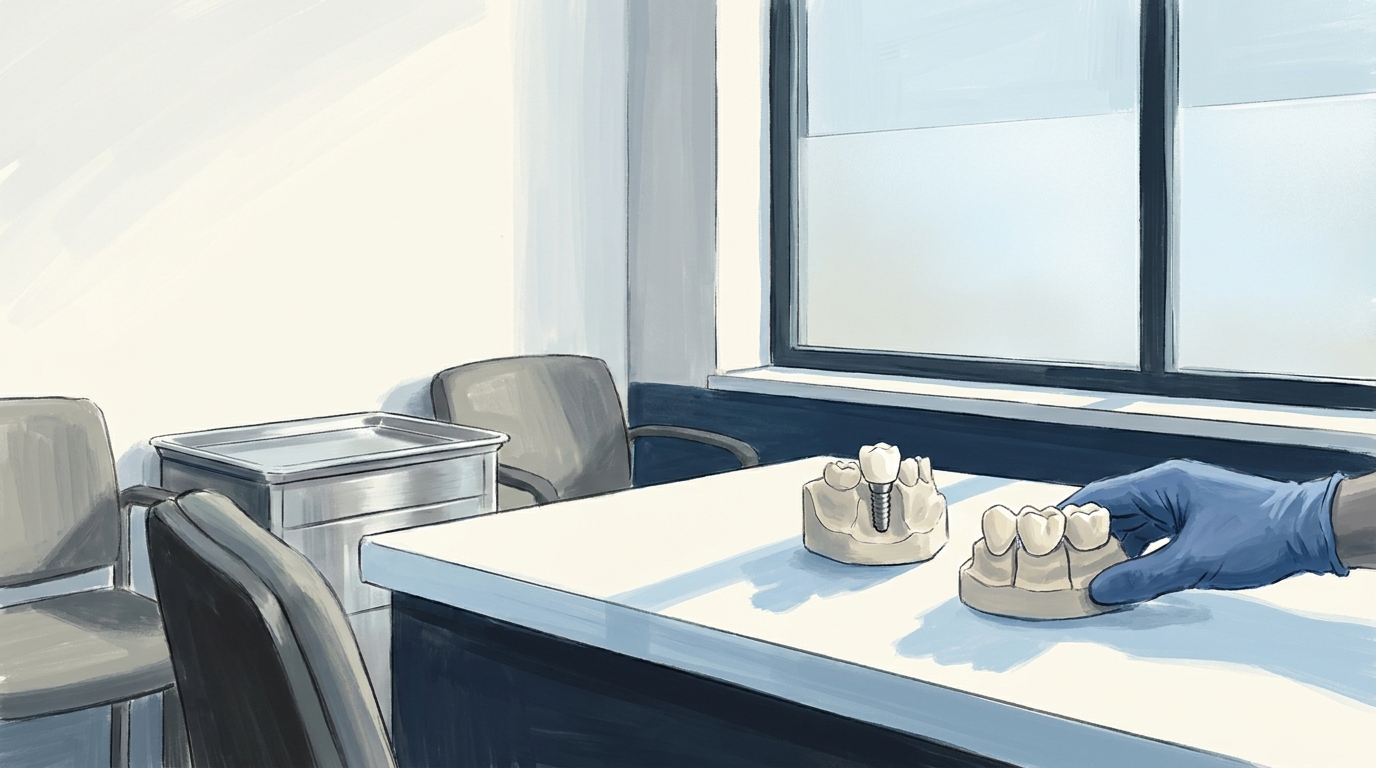
For a single missing tooth in Irvine, a dental implant is usually the better long-term fix when the adjacent teeth are healthy and your bone and gums can support surgery. A traditional bridge wins when the neighboring teeth already need crowns, when you can't accommodate surgery, or when you need a faster, less invasive solution. Everything else is a matter of specifics — and this guide walks through them.
What's the short answer: implant or bridge?
Choose an implant when your neighboring teeth are intact and you want to preserve them, your bone and gum health are adequate, and you can accommodate a surgical healing period. Choose a bridge when the adjacent teeth already need crowns, surgery isn't practical, or you need a faster restoration. For most healthy adults replacing one tooth, implants offer the stronger long-term outcome.
How do implants and bridges actually differ?
An implant replaces the root and the crown; a bridge replaces only the visible tooth by anchoring to the teeth on either side. Dental implants are surgically placed into the jaw to replace a missing tooth root and support artificial teeth such as crowns, bridges, or dentures. A conventional three-unit bridge, by contrast, shapes the two adjacent teeth into supports for a connected replacement.
Endosteal implants are surgically placed into the jawbone, anchoring the replacement tooth at the root level. That root-level anchoring is what gives implants their distinct long-term advantage: the jawbone stays stimulated, and healthy neighboring teeth stay untouched.
At Rice Dentistry in Irvine, implant planning uses advanced 3D surgical design, which is particularly useful when placement angles, nerve proximity, or bone volume are tight. Dr. Nicolas Ravon, part of the Rice Dentistry team, holds a specialist certification in periodontology, a discipline with advanced training requirements beyond dental school.
How do implants and bridges compare head-to-head?
The table below summarizes the practical tradeoffs Irvine patients weigh most often. Treat it as a decision framework, not a quote — the right answer depends on your exam and imaging.
| Dimension | Single-tooth implant | Conventional 3-unit bridge |
|---|---|---|
| Effect on neighboring teeth | None — stands alone | Adjacent teeth shaped into crowns |
| Bone preservation | Stimulates jawbone at the site | Does not address underlying bone loss |
| Treatment timeline | Several months of healing after placement | Typically weeks |
| Surgery required | Yes | No |
| Best candidate | Healthy bone and gums; intact neighbors | Adjacent teeth already need restoration |
| Long-term outlook | High survival with maintenance | Depends on health of supporting teeth |
How long do dental implants last compared to bridges?
Published survival estimates for implants supporting single crowns are high, and three-unit tooth-supported and implant-supported fixed bridges show similar annual survival rates for both the supporting teeth and the restorations themselves, according to systematic reviews. In practice, implants frequently last decades with proper care, while bridges often need replacement sooner because they depend on the longevity of the anchor teeth.
The healing process for a dental implant can take several months or longer, during which a temporary restoration is typically in place. That upfront time investment is what buys the long runway — once the implant integrates, you're not re-doing it on a predictable schedule. A bridge, by contrast, is only as durable as its weakest supporting tooth; if an anchor develops decay or fractures, the whole span is at risk.
What's the cheapest way to replace a missing tooth in Irvine?
In pure upfront cost, a conventional bridge is almost always less expensive than an implant, and non-surgical alternatives can be lower still. In pure upfront cost, a conventional bridge is almost always less expensive than an implant, and non-surgical alternatives can be lower still.
The catch is that "cheapest upfront" and "cheapest over a lifetime" are rarely the same answer. A bridge that needs replacement in ten years — plus potential root canals or extractions on the anchor teeth — can meet or exceed implant cost by the time you're done. Rice Dentistry provides individual estimates after evaluation; itemized quotes should spell out imaging, extraction (if needed), the implant fixture, abutment, final crown, any grafting, and the temporary restoration so you can compare apples to apples. Coverage varies by plan, so most patients rely on private dental insurance or self-pay for either option; ask each office for a written, itemized estimate.
Which option suits which Irvine patient?
Implants tend to suit patients who want to preserve healthy neighboring teeth, have adequate bone (or are open to grafting), and can accommodate a staged timeline. Bridges tend to suit patients whose adjacent teeth already need crowns, who can't undergo surgery, or who need a faster fixed replacement. For multi-tooth gaps, an implant-supported bridge — which Rice Dentistry's reconstructive services include alongside All-on-X and full mouth reconstruction — often outperforms a long tooth-supported span.
Irvine's demographics are also worth factoring in. The city's professional workforce skews toward patients who want a one-time, long-horizon solution and have the schedule flexibility to accommodate implant healing. For patients commuting from Woodbridge, Northwood, or Turtle Rock, Rice Dentistry's offering of both in-person and virtual consultations makes staging a multi-visit implant plan more practical. Rice Dentistry has been serving patients in and around Orange County since 1987, which matters for a treatment measured in decades rather than months.
What should you ask before committing in 2026?
Walk into the consultation with a list. The questions that actually move the decision are specific:
- Is the quoted price for the full restoration — implant, abutment, and crown — or only part of it?
- Do I need extraction, bone grafting, or a soft-tissue procedure first?
- What is the implant brand, and what's the warranty?
- If I choose a bridge, what shape are my anchor teeth in, and what's their expected lifespan?
- What happens if the implant doesn't integrate, or if a bridge-supporting tooth fails later?
- What will my dental plan cover, and what's my written out-of-pocket estimate?
Rice Dentistry builds tailored treatment plans from in-person or virtual consultations, so these answers come out of your actual exam and imaging — not a generic price grid.
Frequently asked questions
Is a dental implant always better than a bridge?
No. An implant is usually the better long-term choice when neighboring teeth are healthy and bone volume is adequate, because it preserves adjacent teeth and stimulates the jawbone. A bridge can be the better choice when the adjacent teeth already need crowns, when surgery isn't advisable, or when the patient needs a faster, non-surgical fixed restoration. The right answer depends on an exam and imaging.
How long do dental implants last in Irvine?
Published survival estimates for implants supporting single crowns are high, and many implants last decades with proper hygiene and regular monitoring. Longevity depends on bone health, gum health, bite forces, and maintenance. A bridge's lifespan, by contrast, is tied to the health of its supporting teeth and often requires replacement sooner than a well-maintained implant.
What's the cheapest way to replace a missing tooth?
Upfront, a resin-bonded or conventional bridge is typically less expensive than an implant. Upfront, a resin-bonded or conventional bridge is typically less expensive than an implant. Over the long term, however, implants often prove cost-competitive because they rarely need replacement and don't risk damaging neighboring teeth.
Does dental insurance cover implants or bridges?
Coverage varies widely by plan. Many dental plans partially cover crowns, bridges, and sometimes implants, but annual maximums often cap benefits well below total treatment cost. Coverage varies widely by plan, and annual maximums often cap benefits well below total treatment cost. Ask your provider for a written pre-treatment estimate and verify what your specific plan covers before scheduling.
How long does the implant process take from start to finish?
The healing process for a dental implant can take several months or longer, during which a temporary restoration is typically in place. From initial consultation through final crown, single-tooth implant cases can span many months, depending on healing and whether additional procedures are needed. Cases requiring extraction or bone grafting take longer. A conventional bridge is usually completed in a few weeks across two or three visits.
Can a bridge be converted to an implant later?
Yes, but it's rarely cost-efficient. If a bridge fails and the anchor teeth are no longer restorable, patients often move to an implant or implant-supported bridge at that point. The challenge is that bone loss may have occurred under the old bridge pontic, sometimes requiring grafting before implant placement. Starting with an implant preserves options.
The bottom line for Irvine patients
For most healthy adults replacing a single tooth, an implant delivers the stronger long-term outcome because it preserves adjacent teeth, maintains bone, and routinely lasts decades. A bridge remains the right call when the neighbors need crowns anyway, when surgery isn't practical, or when timeline pressures dominate. The decision hinges on your bone, your gums, the condition of the teeth on either side of the gap, and your horizon.
Readers in Irvine who want this evaluated professionally can reach Rice Dentistry at (949) 551-5902 or https://irvinedentalcare.com to schedule an in-person or virtual consultation and get a written, itemized treatment plan.