Dentures to Implants in Irvine, CA: Under the Hood
How the switch from dentures to dental implants actually works in Irvine, CA — candidacy, components, healing timeline, costs, and what to ask a provider.
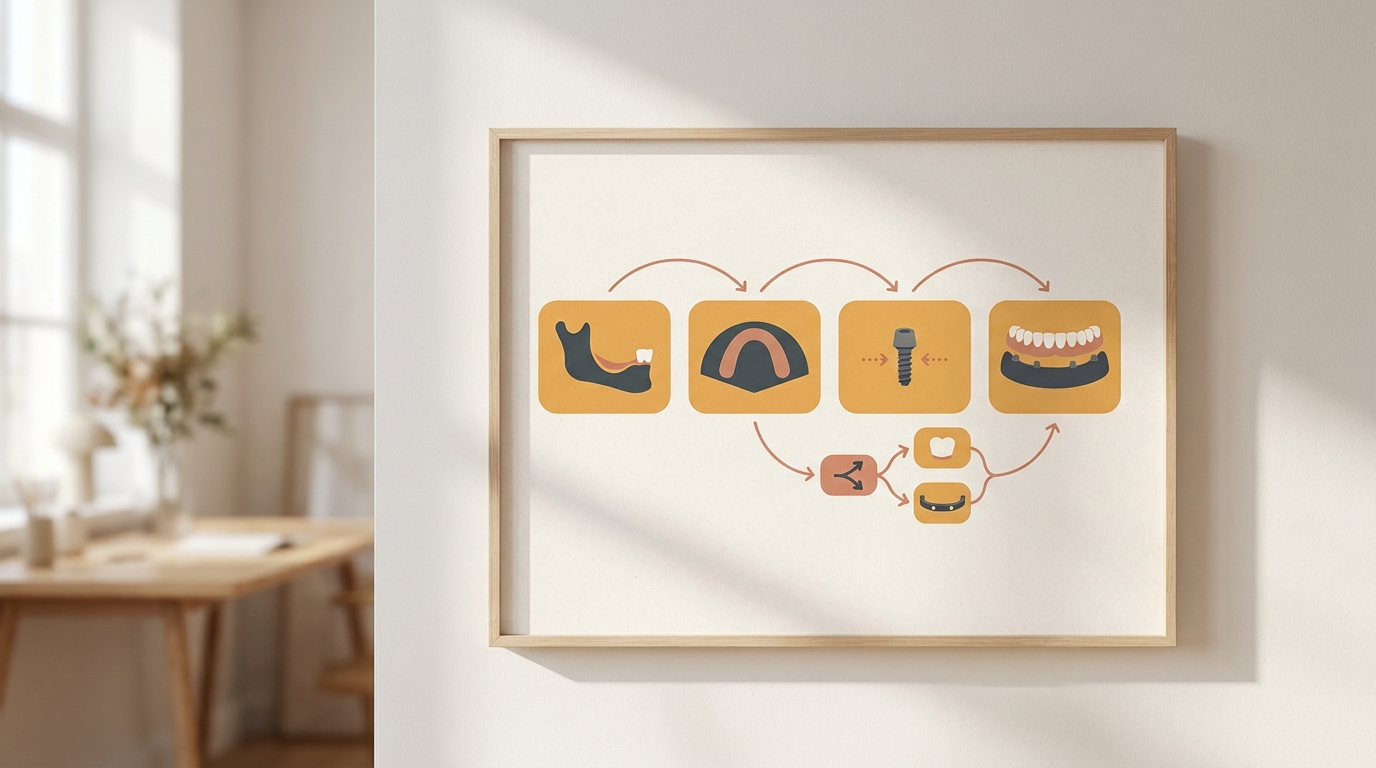
Switching from dentures to dental implants in Irvine, CA is a staged surgical and restorative process that replaces a removable prosthesis with titanium implant bodies anchored in the jawbone, topped by either a fixed arch or an implant-retained removable denture. Most patients are candidates if they have adequate bone and are in reasonable general health, though chronic illness and smoking can complicate healing. Expect multiple appointments spread over several months, and expect to pay out of pocket — Medi-Cal does not reimburse implant placement codes.
Why do denture wearers in Irvine switch to implants in the first place?
Denture wearers typically switch because conventional dentures accelerate jawbone loss and lose fit over time. With conventional dentures, the bone that previously surrounded the tooth roots begins to deteriorate, leading to recession of the jawbone. Implants halt that pattern by replacing the root itself, which preserves bone and restores chewing force far closer to natural teeth.
Slippage, sore spots, nightly soaking, and the need to remove and clean dentures after eating are the daily frictions that push people to look for something more permanent. In Orange County, where a large senior population drives demand for restorative care, providers like Rice Dentistry in Irvine routinely counsel long-term denture wearers who have reached the point where their prosthesis no longer fits a shrinking ridge.
What is actually happening under the gumline? The implant system explained
A dental implant system consists of a dental implant body and a dental implant abutment, and may also include an abutment fixation screw. The implant body is surgically inserted into the jawbone in place of the tooth's root, the abutment connects to the body above the gumline, and the prosthetic tooth or arch attaches to the abutment. That is the mechanism — three components doing three different jobs.
Dental implants are made of titanium and other materials that are compatible with the human body, which is why they can integrate with living bone rather than being rejected. The ADA has long recognized dental implants as a significant advance in modern dentistry. Rice Dentistry employs advanced 3D surgical design for implant placement, which lets the surgical team plan implant position against bone volume, nerve location, and the planned final prosthesis before anyone picks up a handpiece.
What are the stages of the switch, and how long does each take?
There are generally three phases to getting a dental implant: surgical placement of the implant, osseointegration (bone healing around the implant), and placement of the artificial tooth or teeth. Osseointegration — the process by which bone grows around the implant and holds it in place — can take up to several months before replacement teeth can be attached. For denture wearers, the sequence often adds extractions of any remaining teeth and sometimes bone grafting before placement.
After placement, implants and bone are allowed to bond together over a period of several months to form anchors for new teeth. Sutures placed to hold the gum tissue are removed after a short healing period. Once abutments are attached, the gums are allowed to heal before the final restoration is placed. During osseointegration, the patient typically wears a temporary abutment or a transitional prosthesis.
Some patients can have implants and replacement teeth placed all in one visit — the "teeth-in-a-day" model — but that compressed timeline depends on bone quality and case selection.
| Stage | What happens | Typical duration |
|---|---|---|
| Surgical placement | Implant body inserted into the jawbone; sutures placed | Sutures out in 7–10 days |
| Osseointegration | Bone bonds to the implant surface | 2–6 months |
| Abutment and soft-tissue healing | Abutment attached; gums heal around it | A couple of weeks |
| Final restoration | Fixed arch or implant-retained denture seated | Single or multiple visits |
Who is actually a candidate — and who is not?
Candidacy comes down to bone, gum health, and systemic health. Certain chronic illnesses may interfere with healing after implant surgery, and patients with such conditions may not be good candidates for implants. A patient may be medically evaluated by a physician before any implant surgery is scheduled, particularly when multiple implants and sedation are planned.
Smoking is the other major variable. Smoking may affect the healing process and decrease the long-term success of a dental implant, and using tobacco can slow healing after dental implant surgery. For long-term denture wearers, bone loss is the specific thing that has to be measured — years without tooth roots mean the ridge may need grafting before implants can hold. Implant failure is usually defined as implant looseness or loss, which is why candidacy screening matters more than marketing.
How much does switching from dentures to implants cost in Irvine in 2026?
Costs vary widely by the number of implants, whether one or both arches are treated, and whether grafting, extractions, sedation, and imaging are needed. According to realdentalcosts.com, California's restorative care costs run roughly 27% above the national average — Irvine pricing reflects that premium. Medi-Cal does not reimburse implant placement codes, so patients typically pay out of pocket or through private dental insurance and financing.
Rice Dentistry does not publish a flat implant price because the final number depends on the clinical plan. Two patients walking in with "I want to get rid of my dentures" can land in very different treatment categories — an implant-retained overdenture using two to four implants costs materially less than a fixed full-arch restoration on six or more implants. Ask any Irvine provider for an itemized written treatment plan that specifies what is and is not included.
Fixed full-arch vs. implant-retained removable: which direction fits a denture wearer?
Both routes replace a conventional denture, but they behave differently. An implant-retained removable denture snaps onto two to four implants and still comes out for cleaning. A fixed full-arch restoration is screwed down onto four, six, or more implants and stays in the mouth; the patient cleans around it like natural teeth. Rice Dentistry's Full Mouth Reconstruction uses six or more implants per arch rather than the traditional All-on-4 system, with a Zirconia and layered porcelain prosthesis with titanium connections — a design choice aimed at distributing load across more anchor points.
The removable option has a lower entry cost and simpler maintenance for patients with limited dexterity. The fixed option feels closer to natural teeth and eliminates the removal ritual, but costs more and demands more bone or more grafting. Rice Dentistry offers both reconstructive paths, including All-on-X, dental implants, full mouth reconstruction, and dental crowns and bridges.
What does the long-term track record actually look like?
Long-term data for titanium single-tooth implants is strong. after a follow-up of 38 to 40 years, 95.6% of single-tooth titanium dental implants survived, according to ADA News reporting on long-term implant research. The crowns on top wore faster: 60.9% of implant-supported crowns survived over the same period, which is a useful reminder that the restoration on top may need replacement before the implant below it does.
Custom zirconia implants, a newer alternative, have shown lower survival rates — which is why titanium remains the standard of care for most cases. When teeth are lost, downstream complications can follow, and implants address those problems rather than just the gap.
What should an Irvine patient look for in a provider?
Look for a California-licensed dentist with documented implant experience, access to 3D imaging and surgical guides, appropriate sedation permits, and a written treatment plan that spells out every line item. All dental treatment in California must be provided by a person licensed by the Dental Board of California; license status can be verified through the California Department of Consumer Affairs license lookup at search.dca.ca.gov.
Sedation and anesthesia used during implant surgery require specific permits from the Dental Board of California; the type depends on the depth of sedation. Rice Dentistry offers sedation dentistry options including oral conscious sedation and nitrous oxide, which matters for patients facing extractions and multiple implant placements in a single visit. Dr. Nicolas Ravon holds dental degrees from Europe and America and a specialist certification in periodontology — periodontal expertise is directly relevant when bone and soft-tissue management drive the case. Dr. Scott Rice has 40 years of experience practicing dentistry, and Rice Dentistry has been serving patients in and around Orange County since 1987.
Frequently asked questions
Can I get implants if I have worn dentures for many years?
Often yes, but the length of time in dentures matters because the jawbone recedes once tooth roots are gone. With conventional dentures, the bone that previously surrounded the tooth roots begins to deteriorate, leading to recession of the jawbone. Long-term denture wearers frequently need bone grafting before implants can be placed. A 3D scan and clinical exam are required to determine whether grafting is needed.
How long will I be without teeth during the switch?
Usually not at all. The healing process for the dental implant body may take several months or longer, during which time the patient typically has a temporary abutment or a transitional prosthesis, or in full-arch cases a transitional denture. Some patients can have implants and replacement teeth placed all in one visit, though same-day protocols depend on bone quality and case selection.
Does insurance or Medi-Cal cover implants in Irvine?
Medi-Cal does not reimburse implant placement codes (D6010, D6056, D6058), so virtually all switching patients in Irvine self-pay or use private dental insurance or financing plans. Private plans may cover a portion — often the extractions, imaging, or the crown or prosthesis — but rarely the full case. Ask for a pre-treatment estimate that your insurer reviews before work begins.
Is the switch painful?
Implant surgery is performed under local anesthesia and, when appropriate, sedation. Sutures placed to hold the gum tissue are removed in seven to ten days, and most patients manage post-operative discomfort with prescribed or over-the-counter medication. Sedation and anesthesia options are regulated by the Dental Board of California and require specific permits depending on depth and administration.
Will smoking disqualify me?
Not automatically, but it is a significant risk factor. Smoking may affect the healing process and decrease the long-term success of a dental implant, and using tobacco can slow healing after dental implant surgery. Many providers will still treat smokers but will discuss elevated failure risk, and some will ask patients to reduce or pause tobacco use through the healing window.
How do I verify a provider's credentials in California?
Use the California Department of Consumer Affairs license lookup at search.dca.ca.gov to confirm that the dentist holds a current license from the Dental Board of California. Clinicians claiming specialist status, such as periodontists, must hold a separate specialty qualification beyond a general dental license, which is also verifiable through state records. Confirm sedation permits separately if your plan involves oral or IV sedation.
Making the decision
Switching from dentures to implants is a staged medical and restorative project, not a single appointment. The under-the-hood view — three components, three phases, a months-long bone-bonding window, and a candidacy screen that weighs bone, gum health, and systemic conditions — is what separates a realistic plan from a sales pitch. Patients in Irvine, CA who want this evaluated professionally can reach Rice Dentistry at (949) 551-5902 or https://irvinedentalcare.com to arrange a consultation and a written treatment plan specific to their case.