Dental Implants With Bone Loss in Irvine, CA: Next Steps
Turned away for implants in Irvine? Learn why candidacy decisions change, how bone grafting works, and what alternatives still restore your smile.
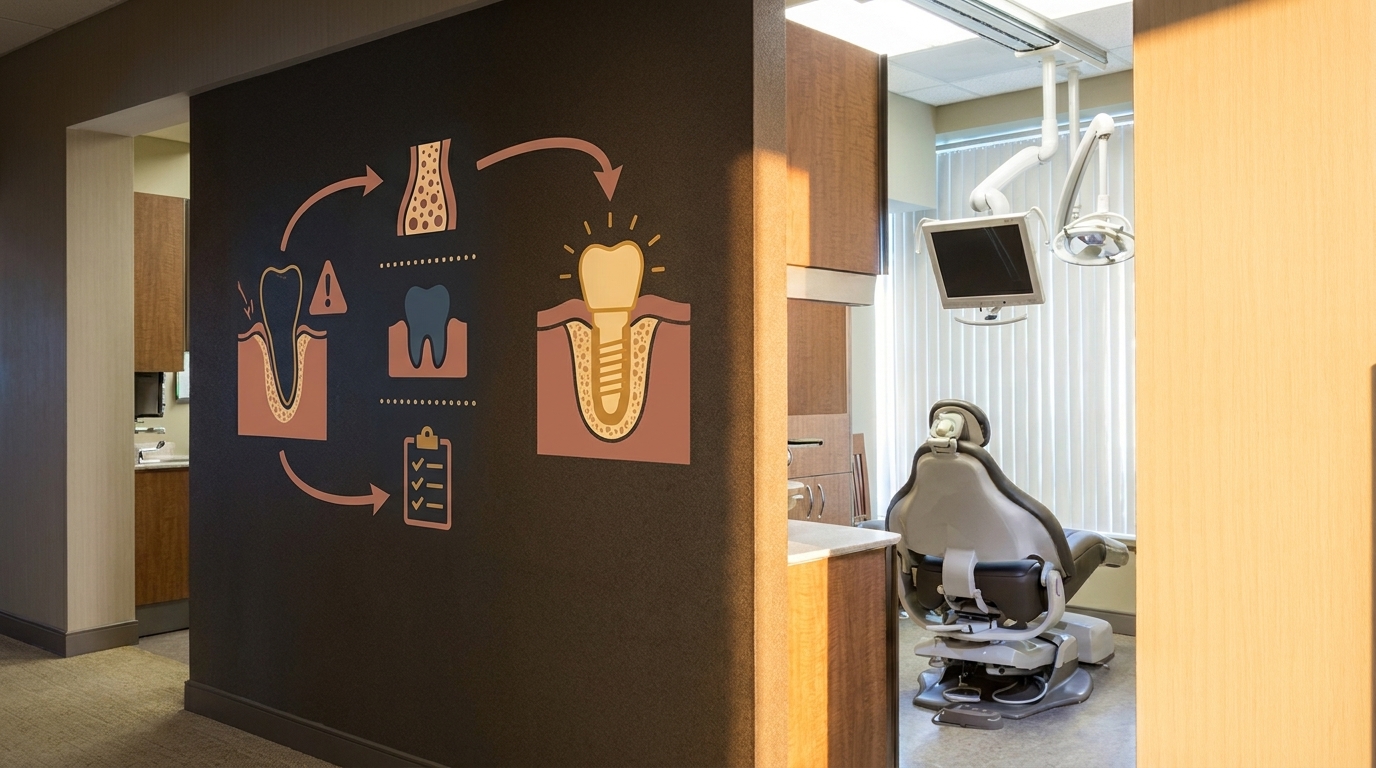
If a dentist has told you that you are not a candidate for dental implants, that answer usually reflects a current condition — insufficient jawbone, active gum disease, uncontrolled health issues, or certain medications — not a permanent verdict. In many cases, preparatory procedures like bone grafting or a sinus lift can change your eligibility over time, and tooth-supported bridges or well-designed dentures remain viable paths to a restored smile. The next step is understanding why you were declined, because the reason determines what you can do about it.
Why were you told you aren't a candidate for dental implants?
The most common reasons for being declined are insufficient bone volume in the jaw, active periodontal disease, systemic health conditions that affect healing, or medications that interfere with bone metabolism. Smoking is another factor — the FDA notes that smoking may affect the healing process and decrease the long-term success of a dental implant. None of these are necessarily permanent disqualifiers.
According to the FDA, a patient's overall health is an important factor in determining whether they are a good candidate for dental implants, how long it will take to heal, and how long the implant may stay in place. That framing matters: candidacy is a snapshot. Treat gum disease, stabilize diabetes, adjust a medication under your physician's guidance, or rebuild missing bone, and the snapshot can change.
At Rice Dentistry in Irvine, we often see patients who were told "no" elsewhere simply because the original provider didn't offer the preparatory procedures — or the imaging — needed to say "yes." A flat rejection without a clear reason is itself a reason to ask more questions.
Can you get dental implants with bone loss?
Often, yes — but it depends on where the bone loss is, how much is missing, and your overall health. Patients with mild to moderate bone loss may qualify after a bone graft or sinus lift rebuilds the ridge. Patients with severe loss in the upper jaw may still be candidates for advanced approaches like angled or zygomatic implants, which anchor into denser bone further back in the face.
Losing a tooth itself accelerates the problem. The FDA notes that when a tooth is lost due to injury or disease, a person can experience complications such as rapid bone loss, defective speech, or changes to chewing patterns that result in discomfort. A dental implant, in turn, helps keep the jawbone from shrinking due to bone loss — which is one reason patients who delay replacement often find the window for a straightforward implant has closed.
The imaging matters here. Rice Dentistry uses cone-beam CT imaging and advanced 3D surgical design for implant placement, which allows the clinical team to see the exact bone volume, nerve position, and sinus anatomy before any decision is made. A flat X-ray cannot show what a three-dimensional scan can — and some "no" answers are really "not without better imaging."
How does bone grafting change the picture?
Bone grafting rebuilds missing jawbone by placing graft material at the deficient site, where it integrates over several months and creates a foundation strong enough to anchor an implant. A sinus lift is a specific type of graft that raises the sinus floor in the upper back jaw to create vertical height for an implant. Both are additional procedures with their own healing time — they are not a guarantee, but they open the door for many patients who were told it was closed.
Timelines overlap with the implant process itself. Grafting adds to the overall timeline, since the graft material must integrate before an implant can be placed. Patients planning around a wedding, a work transition, or seasonal travel often start the conversation six to twelve months before they want the final restoration seated.
It's also worth understanding the components. A dental implant system consists of a dental implant body and dental implant abutment and may also include an abutment fixation screw, with the implant body surgically inserted in the jawbone in place of the tooth's root. Grafting simply ensures there is enough bone for that body to integrate.
What non-implant alternatives still restore function?
If implants aren't the right path — now or ever — removable partial dentures, complete dentures, and tooth-supported bridges all remain viable depending on your situation. The ADA states that treatment options for missing or failing teeth may include restorations, crowns, bridges, implants, or prosthetics like dentures, depending upon the diagnosis, individual's oral health status, and the patient's needs and preferences.
The table below summarizes how the main alternatives compare on the factors Irvine patients ask about most often:
| Option | Bone required | Preserves jawbone | Typical timeline |
|---|---|---|---|
| Single implant + crown | Adequate ridge at site | Yes | Several months or longer |
| Implant after bone graft | Can be rebuilt | Yes | Grafting + several months |
| Tooth-supported bridge | No | No | Weeks |
| Removable partial denture | No | No | Weeks |
| Complete denture | No | No | Weeks |
The ADA also emphasizes that preserving healthy dentition is always a consideration when developing treatment options — meaning a bridge that grinds down two healthy teeth isn't automatically a better choice than a well-planned implant, and a denture isn't automatically worse. The right answer is the one that fits your mouth and your goals.
What about full-arch and advanced approaches when bone is severely limited?
For patients with widespread tooth loss and significant bone loss, full-arch solutions can work when single implants cannot. Rice Dentistry's Full Mouth Reconstruction uses six or more implants per arch rather than the traditional All-on-4 system, with a Zirconia and layered porcelain prosthesis with titanium connections. More implants distribute chewing force across more anchor points, which matters when the remaining bone is compromised.
In extreme upper-jaw bone loss, zygomatic implants anchor into the cheekbone rather than the maxilla, bypassing the grafting step entirely. These are specialized cases — Rice Dentistry's published services describe offering grafting, sedation, full-arch treatment, and advanced implant approaches including angled and zygomatic implants, giving patients a path even when conventional implants aren't possible.
Risks exist with any surgical approach. Advanced techniques exist precisely to manage the risks that come with any surgical approach in difficult anatomy. Advanced techniques exist precisely to manage these risks in difficult anatomy.
Should you get a second opinion in Irvine?
Yes — the ADA explicitly encourages it. The ADA states that patients are encouraged to ask questions about their treatment options and alternatives, and if they are uncomfortable with what is being recommended, they should feel free to seek a second opinion. A "no" from one office is not a verdict from the profession.
The ADA also advises that any discussion regarding the financing of complex dental procedures such as implants or full-arch implants should take place only after patients have discussed the range of treatment options with their dentists. If a provider led with payment plans before explaining why implants were off the table, that's a reasonable signal to get another look.
For Orange County patients, access matters. Rice Dentistry is located on Laguna Canyon Road in Irvine, serves patients from across Orange County, and offers both in-person and virtual consultations — useful for anyone commuting from Woodbridge, Turtle Rock, Northwood, or coastal cities who wants a preliminary review before committing to a full workup. Dr. Scott Rice has 40 years of experience practicing dentistry, and Dr. Nicolas Ravon holds dental degrees from Europe and America along with a specialist certification in periodontology — the discipline most relevant to bone, gum, and implant-site evaluation.
Frequently asked questions
Does being told "no" by one dentist mean no implants ever?
No. A "no" from one provider typically reflects your current situation — bone volume, gum health, medications, or a condition that needs managing first — not a permanent verdict. The ADA encourages patients uncomfortable with a recommendation to seek a second opinion. Another provider with advanced imaging, grafting capability, or experience in full-arch and zygomatic approaches may reach a different conclusion about your candidacy.
How long does bone grafting add to the implant timeline?
Bone grafting typically adds several months of healing before an implant can be placed, because the graft material needs time to integrate with your existing bone and form a stable foundation. The implant healing process itself takes additional time after placement. Total timelines from graft to final crown often run six to twelve months, depending on the site and the amount of bone rebuilt.
Can I skip the implant entirely and still restore my smile?
Yes. Tooth-supported bridges, removable partial dentures, and complete dentures all remain viable alternatives. The ADA lists restorations, crowns, bridges, implants, and prosthetics like dentures as options depending on diagnosis, oral health status, and patient preferences. Non-implant options don't preserve the jawbone the way an implant does, but they can restore chewing, speech, and appearance effectively when implants aren't the right path.
Will smoking really affect whether I'm a candidate?
It can. The FDA notes that smoking may affect the healing process and decrease the long-term success of a dental implant. Many providers ask smokers to quit or significantly reduce use before and during the healing window to improve the odds of integration. Smoking alone doesn't automatically disqualify you, but it is a factor your clinical team will weigh when evaluating your candidacy and treatment plan.
What is a zygomatic implant, and when is it used?
A zygomatic implant anchors into the cheekbone rather than the upper jawbone, which is useful for patients with severe upper-jaw bone loss who would otherwise need extensive grafting. Rice Dentistry's published services describe offering advanced implant approaches including angled and zygomatic implants. These are specialized cases typically reserved for full-arch reconstructions where conventional implants aren't possible because the maxilla cannot support them.
Where can I get full mouth dental implants near me in Irvine?
Rice Dentistry is located at 15785 Laguna Canyon Rd Ste 200 in Irvine and serves patients from across Orange County. The practice offers reconstructive dentistry including All-on-X, dental implants, full mouth reconstruction, and crowns and bridges, with cone-beam CT imaging and 3D surgical design for implant planning. Both in-person and virtual consultations are available for patients who want a preliminary review before scheduling a full workup.
The bottom line for Irvine patients
Being told you aren't a candidate for implants is the beginning of a conversation, not the end of one. The reason behind the rejection determines the path forward — bone grafting for insufficient ridge, periodontal treatment for active gum disease, medical coordination for systemic issues, or a well-designed bridge or denture when implants genuinely aren't the right fit. What matters is getting a clear answer and a real plan.
Patients in Irvine and across Orange County who want a second look can reach Rice Dentistry at (949) 551-5902 or https://irvinedentalcare.com to discuss imaging, candidacy, and the range of options — implant and non-implant — that fit their situation.